
About this post
This is the second post about master’s degrees for impactful US policy work. Part 1 discusses what policy master’s degrees are, why and when you might want to do one, and possible alternatives. Part 2 (this post) considers criteria for choosing where to apply, specific degrees we recommend, how to apply, and how to secure funding. We also have a US policy master's database if you want to compare program options (see also this list of European programs).
Part 1 | |
| Part 2 | US Policy Master's Degrees: Top Programs, Applications, and Funding |
If you are interested in applying for a policy master’s program—including if you are still unsure or plan to apply in future years—we encourage you to fill in this form so that we can potentially support your application and connect you with others who have gone through the program.
This post focuses on building career capital for US federal-level technology and security policy work, particularly in AI policy and pandemic preparedness policy. But much of the advice is also relevant to people seeking to work in other US policy areas.
Summary
- How should I choose where to apply? Many considerations influence which degree you should apply for. These include both degree-specific criteria like the subject, curriculum, opportunity cost (i.e. workload, flexibility, compatibility with work), network (i.e. alumni, faculty, and cohort), ease of admission, tuition cost, and availability of financial aid; and also school-specific criteria like the location, reputation, and on-campus work opportunities. The importance of these factors depends on your professional goals and personal preferences. In our view, job compatibility (i.e. evening classes, part-time options, low workload) is an especially important and underappreciated criterion since working in policy alongside graduate school can advance your career and help pay for your education. [read more]
- Which schools and programs would you recommend? Our policy master’s database includes ~20 degrees that will set you up well for a policy career. The database allows you to filter by subject, location, and more. Which choice is best will depend on your individual circumstances. We often recommend high-ranked DC-based schools and programs, especially the MA Security Studies at Georgetown University, followed by the MA International Relations at Johns Hopkins University. Less competitive DC-based policy schools can be great options too, including George Washington University, American University, George Mason University, and the University of Maryland. Outside of DC, we most recommend policy master’s programs at Harvard, Princeton, Yale, Stanford, Columbia, and Tufts. [read more]
- How selective are policy schools? Policy master’s degrees (even the top ones) are relatively easy to get into, especially compared to top undergraduate degrees, law school, or many STEM degrees. We estimate that the acceptance rates typically range between 15-50% for the top schools, and they can be as high as around 80% for less competitive schools. Many top policy schools report an average GPA of around 3.6-3.7 with pretty wide margins, meaning that many people with GPAs below 3.5 still get admitted (especially if they have significant professional experience to compensate for low GPA and GRE scores). For the less selective schools, a GPA above 3.0 is often sufficient. [read more]
- When are applications due? Fall cohort applications are usually due sometime between December and February, and spring cohort applications around October of the previous year. Funding deadlines can be even earlier. [read more]
- What factors matter for admission? While admission systems vary by school and program, policy master’s acceptance criteria typically include, in no particular order[1], (1) a good undergraduate GPA and scores on standardized tests, particularly the GRE; (2) relevant work experience, including internships and extracurriculars; (3) strong letters of recommendation from college professors or professional contacts; and (4) a clear motivation for your chosen degree in your statement of purpose and other application materials. [read more]
- What do policy master’s degrees cost? The price of a graduate degree includes both the direct costs (tuition, living costs, health insurance, etc.) and the foregone income from (partially) leaving the workforce. The sticker price for the top policy master’s degrees ranges from about $31,000-66,000 per year in tuition fees. [read more]
- Can I get financial aid? Most graduate schools offer substantial merit-based or need-based financial aid, so many students pay less than the sticker price (though schools vary drastically in whether they offer aid and how much). A few select schools offer all policy master’s students full tuition scholarships, including Princeton and Yale. Since most financial aid is offered to the strongest applicants, having good college grades, work experience, etc. helps not only with admissions but also with making graduate school affordable. Many policy master’s programs (especially in DC) also allow students to work part- or even full-time, significantly reducing the “foregone income” cost. [read more]
- How can I fund my degree? Beyond merit-based or need-based financial aid offered by many schools, the main funding options include (1) federal financial aid, (2) loans, including loan forgiveness programs, (3) working alongside your degree, (4) government scholarship-for-service programs, (5) employer funding, and (6) philanthropic scholarships. [read more]
I. Choosing a policy master’s program
Where to apply: Process and criteria for choosing a degree
Which criteria are most important to choosing your degree depends on your individual circumstances, goals, and interests. Beyond the tuition cost and financial aid availability discussed later, this section addresses other important criteria, including:
- Subject and curriculum
- Location
- Reputation
- Opportunity cost (i.e. job compatibility, duration, workload, and flexibility)
- On-campus work opportunities
- For international students: “STEM” degrees
- Special degree features (i.e. part-time, accelerated, and dual/joint degrees)
We highly recommend speaking with current and former students in the programs you are considering. This is a good way to gather information—that you’re unlikely to find online—about a program, identify alternatives, and create a stronger application.[2]
Subject and curriculum
Your best preparation for a policy career is likely a practitioner-oriented policy master’s degree in a subject like “Public Policy/Administration” (MPP/MPA) or “International Affairs/Relations/Security Studies” (MA/MIA). The first post in this series describes the (small) differences between MPP and MIA degrees,[3] the distinction between practitioner-oriented and highly academic degrees, and alternatives to policy master’s degrees (like STEM degrees, law school, and PhDs).
MPA and MIA degrees are typically fairly broad and general, while offering some specializations.[4] There are also more specialized policy degrees on topics like biodefense. We usually recommend more general degrees over highly specialized ones due to their greater option value. While specialized degrees provide more relevant career capital for one specific policy area, they can make switching later more costly. Given that there are many ways to specialize in the course of a more general degree (e.g. through internships, course selection, and research work), we only recommend such specialized degrees if you’re very confident in your policy area/cause of focus.
More important than the degree title is the curriculum. When spending time on your degree, you want to learn about or research important topics and develop crucial professional skills like writing. What topics are “important” is person-specific, depending on your interests and professional goals.
The ideal policy master’s program has few mandatory classes or the mandatory classes mainly cover topics relevant to your future work, and many relevant elective classes. If you’re interested in AI policy, your degree should offer many classes on topics like AI, cybersecurity, technology policy, export controls, industry regulation, US-China relations, etc. Ideally, you also avoid unnecessary or unappealing academic requirements, like (potentially) foreign language or introductory economics requirements.[5] Many policy master’s have a thesis requirement, while others make the thesis optional. A thesis can be a good opportunity to dive deeply into one relevant policy area but often involves substantial work (the effort required to complete a thesis varies widely between schools and programs).
Policy master’s programs differ greatly in their number and relevance of mandatory and elective classes. As such, it is important to gather information about the curriculum before choosing a degree. While some of this information is available online, it’s helpful to also speak with current students—ideally, those interested in your policy area—about which classes they have taken and how useful they were.
The major policy schools are typically quite large, with hundreds of students graduating every year. As such, their course offering is often diverse, addressing even relatively niche topics—such as AI or biosecurity (see footnote for a particularly relevant class offering[6]).
Location
To prepare for a policy career in/around the US federal government, we recommend attending a Washington, DC-based policy school, all else being equal. Policy master’s at DC schools are best optimized to help you build policy-relevant career capital, including through opportunities to learn about, network, and work in policy during your degree.
The most prestigious DC policy schools are Georgetown University and Johns Hopkins SAIS. Other DC-area schools offer similar benefits, and while they are somewhat less prestigious, they’re also typically cheaper and less competitive. These include George Washington University, American University, George Mason University, and the University of Maryland. We provide more details below on the master’s degrees offered at these schools.
Ideally, you’ll work or intern in policy alongside your master’s, and DC is where most federal policy jobs are. Master’s programs at DC universities are frequently designed to allow students to intern and work part- or even full-time while completing their degree (thanks to lower workloads, evening classes, etc.). This significantly reduces the opportunity cost of studying (though international students face some work restrictions). Even in non-DC degrees, you can typically do a DC-based summer internship between your first and second year (often fully-funded by the school).
Attending a DC policy school also likely provides you with the best networking opportunities for policy work.[7] In these schools, your professors are mostly adjunct faculty with policy jobs and decades of experience; your classmates often work in policy alongside graduate school; your school’s alumni network consists of thousands of graduates across all DC policy institutions and levels of seniority; you’re more likely to interact with high-level guests/officials; and your school’s career services are experienced supporting policy-interested students.[8]
DC schools also have the best track record—with minor exceptions like the Harvard Kennedy School—of their graduates successfully entering policy roles. For example, four of the top five schools attended by White House staffers in 2011 were in DC.[9] Presidential Management Fellows also disproportionately tend to come from DC schools. Similarly, among Congressional staffers with a graduate degree, four of the top five schools were DC-based in 2019, with one article concluding that “if you want to work in Congress, being educated next door helps.”[10]
While DC location benefits are one important consideration, DC policy master’s aren’t strictly preferable to non-DC degrees. Outside of DC, the schools with top policy programs—like Harvard, Princeton, Yale, Stanford, Columbia, and Tufts—typically provide many but not all of the same benefits as DC programs. For example, these schools generally also offer strong policy networking opportunities but they score worse on job compatibility (being able to have a policy job during the degree) than many DC programs. Of course, the above non-DC schools have some other compensating benefits, including their prestige and the generous funding at Princeton and Yale.
Reputation
Attending a prestigious, high-ranked university strengthens the credential of your graduate degree, partly by signaling that you were smart and accomplished enough to gain admission.[11] Prestige typically comes much more from the school’s name than that of the degree: MA, MPP, MPA, MIA—that's an alphabet soup to employers.
School reputation also correlates with factors making your education more valuable, like having especially bright, ambitious classmates; field-leading professors; elite visitors; relationships with major (policy) institutions; access to influential alumni; and special career support programs and resources.
Completing a master’s degree at a top-ranked school increases your chances of getting competitive job opportunities during the degree or after graduation. Chris Blattman, Professor of Global Conflict Studies at the University of Chicago’s Harris School of Public Policy, notes that “careers are path dependent, and…a better first job could lead you on a different, higher, faster-paced trajectory.”[12] He also describes who may benefit most from attending a prestigious university:
“Eliteness is more valuable for ambitious people who have [relatively little] work experience, are newly entering the non-profit or public sectors, or are looking for a change in career or country. If you have a long CV in these sectors, plan to hold onto an established job, or want a life rather than a career in the fast lane, then the eliteness of the institution matters much less.”
Reputations of international relations (IR) programs: According to the 2018 TRIP survey of US IR faculty (underlying the ranking in Foreign Policy), the most prestigious IR master’s degrees are offered by these schools[13] (% of professors who put a school in the top five):
- Georgetown University (61%)
- Harvard University (49%)
- Johns Hopkins University (48%)
- Princeton University (38%)
- Columbia University (37%)
- Tufts University (31%)
- George Washington University (29%)
- American University (21%)
- London School of Economics (18%)
- University of Chicago (14%)
From a policy career perspective, we are much more interested in which programs US policy professionals believe are best rather than academics—who are likely to overweight academic factors relative to policy pipelines, favoring schools like Harvard, Princeton, and Columbia—but the TRIP survey is the best source we found. And the TRIP results are noteworthy in several ways (see footnote[14]).
Reputations of public policy programs: The US News & World Report Best Public Affairs Programs ranks MPA/MPP programs by asking academic “deans, directors and department chairs” to assess the “academic quality” of different programs. This suffers from the same weakness as the TRIPS survey above since we’re much more interested in the assessments of US policy practitioners and also not just assessments of programs’ “academic quality” but of all their important features. So we don’t recommend many of the US News & World Report high-ranked MPA/MPP degrees, but favor DC-based or otherwise outstanding schools. Of the MPA/MPP degrees we recommend in our database, the school rankings are as follows:
- Harvard Kennedy School (#3)
- UC Berkeley, Goldman School (#3)
- American University, School of Public Affairs (#10)
- Georgetown University, McCourt School (#12)
- George Washington University, Trachtenberg School (#12)
- Princeton University, School of Public and International Affairs (#12)
- Carnegie Mellon University, Heinz College (#12)
Opportunity cost
Graduate degrees have a high opportunity cost, which can differ drastically between programs. Policy master’s are often designed to be relatively time-efficient—compared to STEM degrees, law school, etc.—but even they still vary significantly. A graduate degree’s opportunity cost depends mainly on its (1) job compatibility (e.g. evening classes, part-time options), (2) duration, and (3) workload. Our policy master’s database includes information on these factors.
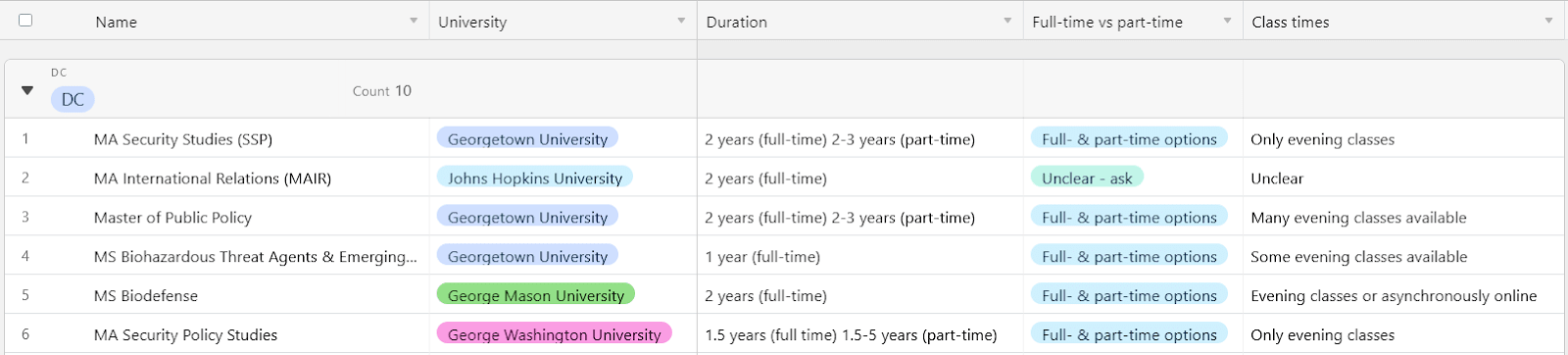
Job compatibility: Some policy master’s are designed to be compatible with a part-time or even full-time job, substantially reducing their opportunity cost.[15] These master’s typically involve (1) a lower workload, (2) evening classes, and (3) flexibility to switch between “part-time” and “full-time” study. For example, Georgetown’s MA Security Studies only has evening classes, and an estimated >80% of students work or intern alongside their degree (often full-time). In contrast, the MPP at Harvard Kennedy School offers few evening classes and while most students work part-time, very few work full-time (Johns Hopkins SAIS and Yale’s MPP are similar[16]).
Duration: US policy master’s programs generally last 2 years (i.e. typically 21 months, including a 3-month summer break) as a “full-time”[17] student, though there are some 1-year (i.e. 9-12 month) programs.[18] Many programs allow for “part-time” study, which may extend the program to 3 years (or you may still finish in 2 years but have to take summer classes). 1-year master's degrees are much more common in the UK, though we don’t generally recommend international programs to work in US policy.
Shorter degrees aren’t necessarily preferable. Graduate school gives you time to learn, network, develop professional skills, intern, etc., which you may get much less of in a 1-year rather than a 2-year degree. Often, 1-year programs also involve a higher workload—cramming more courses into that year—making it harder to hold a full-time or part-time job alongside your studies. This can make the opportunity cost higher than for a 2-year program that allows you to work on the side.
Workload: Master’s degrees vary a lot in how many hours they require you to spend per week on coursework—including time spent in classes and outside on reading and assignments. It can be difficult to assess a degree’s workload from the outside since most schools don’t provide (reliable) information on workload requirements outside of class. We recommend asking current students or alumni about their degree’s workload.
Also, while “credits” or “credit hours” are rarely directly comparable across schools, they can be helpful to compare the workload (and tuition cost) of different degrees offered by the same school. For example, consider the following Georgetown degrees:
- Georgetown’s 2-year MA Security Studies involves completing 36 credits (i.e. 9 per semester)
- Georgetown’s 2-year MPP involves 48 credits (i.e. 12 per semester)
- Georgetown’s 1-year MS in Biohazardous Threat Agents & Emerging Infectious Diseases involves 30 credits (i.e. 15 per semester).
One potential downside of completing a lower-workload degree is that you’ll take fewer classes and build less knowledge and skills in the program (see caveats in footnote[19]), but for most applicants we expect this to matter much less than other factors, including degree duration.
Some policy degrees require completing a degree-relevant summer internship between your first and second year, which is more common in programs with an optional thesis. This is usually not a demanding requirement since you’ll likely want to do a policy-related summer internship anyway to prepare optimally for a policy career.
On-campus work opportunities
Graduate school can offer opportunities to work on relevant topics with professors or at university-affiliated research institutes. It should factor into your decision whether the school has faculty or entire research institutes working on relevant topics, which you can usually find out about online.[20] This is especially important for international students who can only work on campus during their first two semesters.
For example, Georgetown University has both the Center for Security and Emerging Technology (CSET) and the Center for Global Health Science and Security (GHSS), both of which frequently hire Georgetown students as research assistants. Similarly, Harvard has the cybersecurity and AI-focused Berkman Klein Center for Internet & Society, UC Berkeley has the CLTC AI Policy Hub, and Stanford has the Existential Risks Initiative, Biosecurity and Global Health Initiative, and Institute for Human-Centered AI.
For international students: “STEM” degrees
For foreign nationals seeking to work in US policy, a graduate degree is typically the most feasible (or the only) option to come to the US for several years and get work authorization.
International students most commonly come to the US on an “F-1 student visa”, which allows working in the US during the degree (with some restrictions) and for up to one year after completion of the degree under a program called Optional Practical Training (OPT). If the degree is classified as “STEM” (Science, Technology, Engineering, Mathematics), the period of post-completion work increases from one year to three years. For international students, this is a substantial benefit of STEM degrees.
What counts as a “STEM” degree isn’t always obvious and is rarely mentioned on university websites; to find out, you may need to contact the university’s admission office. Universities are incentivized to get degrees categorized as STEM if possible for immigration reasons, and so most “surprises” are degrees that unexpectedly receive this classification—the percentage of STEM content required for a degree to be classified as such is pretty low. So if you’re an international student, look out for and consider doing a “STEM”-classified policy degree with some minimal data science or technology content, such as the Master of Public Policy at Georgetown University’s McCourt School.
Special degree features: part-time, accelerated, and dual/joint
Some policy master’s programs have special characteristics that might make them more attractive. For example, it is common (but not universal) for degrees to offer part-time options, which makes it easier to combine graduate school with holding a job (see above). One option to reduce the time-cost of graduate school is to do a 5-year accelerated BA-MA degree, but this comes with significant downsides (as discussed in part 1).
Some schools offer dual degrees (also called joint degrees), combining a policy master’s degree with another graduate degree, such as law, business, or public health. An example is Georgetown University’s joint JD-MA Security Studies degree.[21] Some dual degrees allow students to study abroad for a part of their degree, such as the Johns Hopkins SAIS-Tsinghua University dual degree in International Relations/Law. Typically, students must be separately admitted to both degree programs. The main advantage of dual-degrees is that they often double-count some courses, so that completing both degrees takes less time and money than if the degrees had been pursued independently—for example, Georgetown’s joint JD-MA Security Studies degree takes four years instead of the five year required to get the JD (3 years) and the MA Security Studies (2 years) separately.
However, while dual degrees can be strong options for some people, we advise most people against pursuing one. Generally, it is unnecessary to have two graduate degrees to get a policy job. And while dual degrees can save some time relative to completing two degrees separately, they usually still cost significantly more time (and money) than doing a single degree. Dual degrees can nevertheless make sense if you seek to specifically become an expert at the intersection of two professional fields—such as law and national security in the case of Georgetown’s joint JD-MA Security Studies degree; or if you would like to study abroad for parts of your graduate degree—which is beneficial if you seek to build regional expertise, such as on China through the Johns Hopkins SAIS-Tsinghua dual degree.
Which policy masters should you consider?
Which master’s programs are “best” ultimately depends on your preferences and professional goals. The following recommendations—both the database and subsequent sections—focus on top-ranked policy programs and less competitive DC policy programs.
Many (but far from all) of the programs included have an international relations and security focus and may be most relevant to people seeking to work in US federal-level technology or security policy, such as AI policy or biosecurity policy. This is informed by the authors’ backgrounds and focus on these policy areas. If you are interested in other policy areas (e.g. global development) but still want to do a policy master’s, much of the tactical advice in this post still applies, but make sure to talk to people in your area about which programs they would recommend.
Policy master’s database
We created a database of the most relevant US policy master’s programs, which currently lists around 20 degrees in the US. See the user guide here.
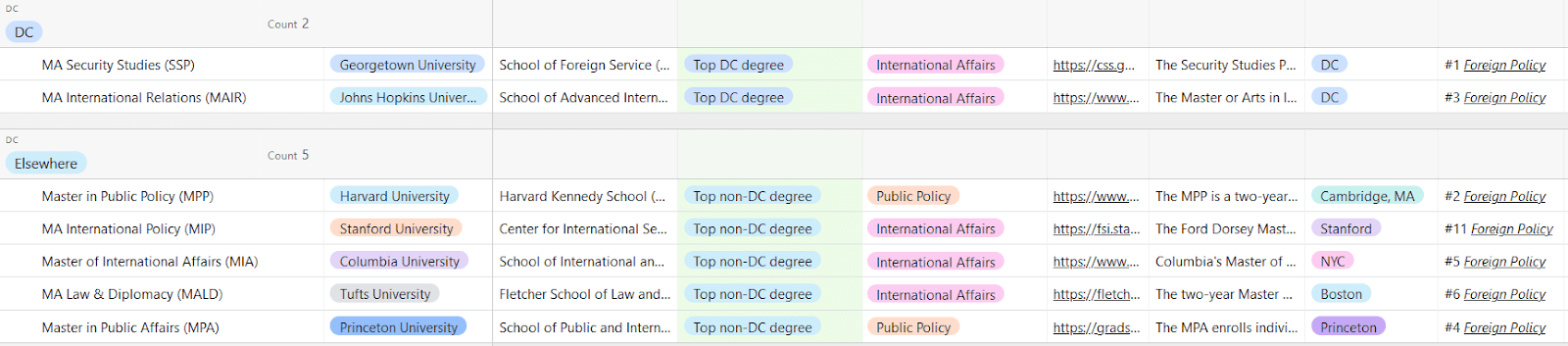
The database is a work in progress, and we appreciate any feedback (e.g. promising master’s degrees we missed, factual errors, better ways to structure the table). The database does not aim to be comprehensive but reflects our best guess at the programs that readers who fall in the category described above should consider.
In addition to our database, APSIA (the Association of Professional Schools of International Affairs) has a useful list of practitioner-oriented policy master’s programs—both in the US and abroad—for people interested in international relations/security/foreign policy.
Top policy master’s programs to consider
This section highlights some of the policy master’s from the database, separately considering programs in and outside of DC. To decide between these programs, you’ll need to research the program specifics and factor in your background and preferences (see the questions below).
While no single option is best for everyone, we want to highlight the MA Security Studies at Georgetown University as a likely top choice for many readers of this post.[22] In brief, this degree scores especially highly on location (being based in DC); reputation (#1 on surveys discussed above); focus (i.e. policy practitioners over academics); job compatibility (i.e. only evening classes, part-time options, low workload); relevant classes (e.g. on AI, biosecurity, nuclear security); few mandatory courses; relevant faculty and on-campus work opportunities (e.g. at CSET and GHSS); flexibility (e.g. summer classes); and relatively low cost and generous financial aid.
DC schools and programs: The most prestigious policy schools in DC are Georgetown University and Johns Hopkins School of Advanced International Studies (SAIS). Other DC-based policy schools, while somewhat less prestigious, are typically cheaper and less competitive while still having high-quality programs. These include George Washington University, American University, George Mason University, and the University of Maryland. Some policy master’s programs at these schools worth considering include (see caveat in footnote[23]):
- Georgetown University:
- School of Foreign Service:[24] MA Security Studies (SSP) (for security, and technology policy)
- McCourt School of Public Policy:[25] Master of Public Policy (MPP)
- Medical Center: MS Biohazardous Threat Agents & Emerging Infectious Diseases (for biodefense and pandemic preparedness)[26]
- Johns Hopkins SAIS:[27]
- MA International Relations (MAIR)
- George Washington University, Elliott School of International Affairs:[28]
- American University:
- George Mason University, Schar School of Policy and Government:
- MA Biodefense (for biodefense and pandemic preparedness)
- MA International Security
- Master's in Public Policy (MPP)
- University of Maryland (UMD), School of Public Policy:
- Master of Public Policy (MPP)
- Master of Public Management (MPM) (mid-career degree)
Non-DC schools and programs: Outside of DC, the schools with top policy programs include Harvard, Princeton, Yale, Stanford, Columbia, and Tufts. The elite status of these schools is a significant advantage over lower-ranked DC programs like George Mason or UMD. At the same time, they might lack some of the benefits of the DC-based schools (such as compatibility with holding a part-time or full-time job). Some of the best policy master’s degrees at these schools include:
- Harvard Kennedy School:[29]
- Master in Public Policy (MPP)
- Master in Public Administration (MPA) (mid-career degree)
- Princeton University, School of Public and International Affairs (SPIA):
- Master in Public Affairs (MPA) (fully-funded)
- Master in Public Policy (MPP) (mid-career degree; fully-funded)
- Yale University, Jackson School of Global Affairs:
- Master in Public Policy in Global Affairs (fully-funded)
- Master of Advanced Studies in Global Affairs (mid-career degree)
- Stanford University, Freeman Spogli Institute for International Studies:
- MA International Policy (MIP)
- Columbia University, School of International and Public Affairs (SPIA):
- Tufts University, Fletcher School of Law and Diplomacy:
- MA Law and Diplomacy (MALD)
It’s not easy to assess and decide between these program options, especially between the more prestigious non-DC schools and the less prestigious DC schools.[30] We recommend that you adjust our general recommendations based on your individual considerations, such as:
- Option value: Do you want your graduate degree to build non-policy career capital, such as for pursuing an academic or technical career? If so, this pushes in favor of more prestigious schools and more academically oriented degrees.
- Prior DC experience: Did you live in DC previously and have already tested your fit for and built DC policy experience, a network, and knowledge? If so, it seems less important to also do a DC-based graduate degree relative to getting a more prestigious non-DC degree.
- Prior work experience: Do you already have several years of work experience? If so, it’s likely less important for you to build additional career capital by working part-time alongside a master’s program (and thus to choose a DC program with high job compatibility).
- Location constraint: Do you have family obligations or a strong preference to live in/near somewhere specific? If so, this should influence your graduate school choice.
- Budget constraint: What are your options to fund graduate school? The more prestigious universities are often (but not always) more expensive, especially when considering part-time degrees (which are mostly in DC) that allow you to work while in school.
We caution against focusing on the programs in our database at the exclusion of all other options. Generally, the details of your (graduate) education seem to matter less and less the further you advance in your career. And it's definitely possible to come from a school not in the database and still end up in a high-level policy role.
Acceptance rates
Policy master’s degrees (even the top ones) are relatively easy to get into, especially compared to top undergraduate degrees, law school, or many STEM degrees.
Most policy graduate schools do not publish (reliable) information on acceptance rates for their programs. We estimate that the acceptance rates typically range between 15-50% for the top schools, and they can be as high as around 80% for the less competitive schools.[31] The most competitive schools are the Ivy Leagues like Harvard, Princeton, and Yale, as well as other prestigious schools like Stanford and MIT.
But the more competitive schools and master’s programs aren’t always preferable. For example, while the top-ranked DC schools (Georgetown University and Johns Hopkins SAIS) have higher admissions rates than the Ivy League schools above, they are typically the better choice for aspiring policy professionals. Even the other DC-based policy schools like George Washington University and American University—which are less competitive still—can be preferable to higher-ranked non-DC schools.
Experience levels and demographics
The average policy master’s student is around 26 years old and has 2-3 years of work experience, though policy schools accept some high-achieving students straight out of undergrad.[32] Having (relevant) career experience can compensate to some extent for worse undergraduate grades, worse results on standardized tests, and a lack of relevant extracurriculars.
As this table shows, the cohort size and the share of international students in many of our recommended policy master’s programs vary widely:
University | Degree | Cohort size | % International students |
Georgetown | ~200-300 | 15% | |
Johns Hopkins SAIS | ~345 | 44% | |
Harvard Kennedy School | ~225 | 28% | |
Stanford | ~30 | 50% | |
Princeton | ~70 / ~20 | 20% / 37% | |
Yale | ~35 | 60% |
There are also dedicated mid-career programs for people further advanced in their careers—usually requiring at least 5-7 years of full-time work experience—such as Harvard’s Mid-Career MPA and Georgetown’s Master of Policy Management. Mid-career programs tend to allow students to study part-time and have less stringent coursework requirements. These programs typically omit internship and “capstone” requirements, recognizing the students’ prior work experience and accomplishments.
II. How to apply: Getting into policy master’s programs
Application timelines
Most policy schools have one annual application cycle for a master’s cohort beginning their studies in the fall semester. But some schools/programs—like Georgetown’s MA Security Studies—have a second annual application cycle for a spring semester cohort.[33]
Applications for the fall cohort are usually due sometime between December and February (i.e. master’s applications for the 2024 fall cohort will be due between December of 2023 and February of 2024). Applications for the spring cohort (if applicable) are usually due around October of the previous year.
Some schools also have an early-decision deadline, which provides clarity/options sooner. These deadlines usually precede the typical December-February timeline.
As you plan out your personal application timeline, focus first on the two components of the application that require the most advanced planning: letters of recommendation and standardized admissions tests like the GRE (see details in sections below).
Most schools will give all fall cohort applicants a decision of some kind—acceptance, rejection, or a waitlist position—by mid-March.
Application prerequisites
Degree programs vary in their prerequisites for admission. Many MPP programs involve some quantitative classes and thus require or prefer a demonstrated background (e.g. college classes) in economics, statistics, and calculus. In contrast, most international affairs programs do not have such requirements, but there are exceptions like the MA International Relations at Johns Hopkins SAIS that requires candidates to “have earned…a B- or higher in separate college-level courses in introductory microeconomics and in introductory macroeconomics.” Check the formal application prerequisites before you apply.
If you’re currently in college and may want to pursue a policy degree in the future, review the requirements at your favored graduate schools and, if necessary, consider taking a few classes in statistics and economics. If you have already finished college, you can take relevant courses online or at your local community college before applying (again, check whether this is actually necessary); many programs also offer options to “catch up” on unmet prerequisite requirements after receiving admission.
Qualitative application components
Application processes generally include both qualitative components (e.g. a resume/CV, personal statement, writing sample, other essays, recommendation letters) and quantitative components (e.g. GPA, GRE/GMAT). They typically do not include interviews with limited exceptions like Johns Hopkins SAIS’ optional interview. Our policy master’s database includes information about these application requirements.
Resume
Master’s applications generally require submitting a one or two-page resume. While most general-purpose advice about resume writing still applies, you should also read some specific graduate school resume advice.
Since policy master’s admissions highly value professional experience, highlight your experiences throughout your application. Consider also how to showcase your personal and professional leadership experiences.
To get feedback and revise your resume, run it by one or more people who are professionally successful, good at writing, and ideally have firsthand experience hiring and resume screening. Attention to detail matters a lot in admissions contexts, so typos can be costly, and it is usually much easier for someone else to spot errors in your writing.
Statement of purpose and other essays
Virtually all schools require you to write a statement of purpose (aka “personal statement”), and many also ask for additional essays (e.g. a diversity statement, short essay questions, an analytic essay). Very few policy master’s programs also ask for a pre-written writing sample, such as a polished college essay or published article.
There are many examples and helpful articles on writing a convincing statement of purpose for graduate school applications.[34] While schools use subtly different prompts, they’re all asking for the same information: What do you want to study at graduate school, and why do you think this area is important to the US government, national security, etc.? Why are you interested in this program in particular? What experience do you have in your field? And what do you plan to do with your degree after graduating?[35]
Given the similarity in prompts, you can usually submit similar statements of purpose to each school, but you should tweak each statement to each specific program (e.g. highlighting particular program features, courses, faculty, and other strengths). To learn more about the unique strengths of particular programs, speak with current students and carefully browse the school/program websites.
Many schools require one or more additional (short) application essays beyond the statement of purpose, but the details vary greatly by school and program. Most commonly, schools ask for a “diversity statement” asking candidates to describe how their demographics and other factors shaped them (see diversity essay advice articles). Schools sometimes also ask for short essays about the candidate’s interest in public service, their graduate school expectations, or a substantive analytic question.
We generally recommend writing an essay even if the school says it’s optional. These essays allow you to say something about yourself the panel cannot immediately glean from your resume. Through your essays, you can demonstrate your skills and interests as well as your professional and academic experiences and thus stand out compared to other candidates who didn’t write an essay (see footnote for essay requirements of several example schools[36]).
Draft your statement of purpose and all your application essays early, and then revise them multiple times based on extensive feedback, ideally from knowledgeable professionals. And make sure to exactly follow each school’s formatting guidance for the essay, such as the page number, font, spacing, whether to include your name, etc.
Letters of recommendation
Virtually all policy schools require two or three letters of recommendation, but they vary in their specific prompts and who they accept as recommenders (see footnote for requirements of several example schools[37]). Many schools specify that they expect at least one recommendation letter from an academic—most commonly, a college professor—and one from a professional contact, such as an employer.
As a courtesy to your recommenders, and to ensure they have time to write you the strongest letter possible, you should ask for the letter at least six to eight weeks before the application deadline (and earlier is generally better).
If you’re still in college and want to prepare for future graduate school applications, prioritize developing relationships with professors now.[38] Be specific with yourself about who these professors will be since you won’t have time to develop these relationships with every professor. Prioritize relationships with professors who you think will take the time to get to know you well and invest in your development (over “big name” professors with more stature or public acclaim); these relationships will typically pay dividends and are more likely to result in recommendation letters you will not have to write yourself. Strong grades and participation in a professor’s class, attending office hours, asking for career advice, or working as a research or teaching assistant can all be good ways to nurture these relationships.
Even if you don’t intend to apply right away, you can ask college professors or colleagues to write a letter while their impressions of you are fresh in their memory, then they can keep the letter on file (and share it with you, if they’re willing to).[39] Since most applications require the recommender to submit their letter directly to the university, they’ll have to eventually email/upload the letter themselves when you apply (most applicants thus never get to see their recommendations). Ideally, you'll want the professor to customize the letter to the particular program you're applying to. Your exact interests may also change between college and graduate school, so you don't want them writing a law school-specific recommendation if you actually end up applying for an MPP (or vice-versa).
Some recommenders may ask you to draft the recommendation letter yourself or to share points you would like to be highlighted. While this can be awkward, it is relatively common. If this happens to you, take the opportunity to ensure that your draft letters highlight different strengths than your personal statement and focus on specific details of your work that your recommenders have observed (see also the many articles with helpful advice).
Quantitative application components
In addition to your undergraduate GPA, many policy schools ask you to submit the results from a standardized admissions test like the GRE or GMAT. Our policy master’s database includes information on which policy degrees require the GRE/GMAT and, when available, the average GPA and GRE/GMAT scores of successful applicants.
GPA
The undergraduate GPA plays an important role in admissions decisions but you don’t need to have been a “straight-A student” to get into the top programs. As the below numbers suggest, you may be able to get into a top program with a GPA of 3.5 or below.
The GPAs for admitted students in several example policy degrees—most schools don’t report this information—are as follows: Georgetown’s MA Security Studies (3.65 GPA mean), Yale’s MPP (3.7 GPA median), Johns Hopkins SAIS’ MAIR (3.45-3.81 GPA middle 50% range), and George Washington University’s Elliott School (3.58 GPA mean). Even in Princeton’s highly competitive, fully funded MPA, 20% of successful applicants have a GPA between 3.4–3.6 and 6% have a GPA below 3.4.
The GradCafe Stats Generator aggregates and plots 1,000+ self-reported GPA and GRE scores of successful policy master’s applicants.[40] This tool confirms that among each policy school’s admitted students, there is a wide spread of GPAs, typically ranging from 3.4–4.0 for the top schools, and down to 3.0 for the less selective schools.
If you’re applying straight out of college, you might need a somewhat higher GPA, but if you already have several years of professional experience, you might be admitted with a lower GPA.
If you are in college, you may want to optimize to some extent for a higher GPA, such as by taking fewer classes so that you have more time to invest in each class (and in valuable extracurriculars). Another strategy is to choose classes in which high grades are more likely.
But it is usually not worth avoiding entire subjects that would otherwise help you achieve a positive impact in your career simply to try to maximize your GPA. While, say, STEM classes often have less generous curves, you may gain valuable knowledge by taking those classes that would be difficult to gather outside the college context. STEM knowledge might be particularly helpful if you’re pursuing a technology policy career, such as one aimed at AI governance or biosecurity. As a simple heuristic: If you were excited to take a class before you started thinking about graduate school admissions, and you think the class will help you have a positive impact later in your career, take the class.
Undergraduate GPAs generally matter a lot less for mid-career programs. For example, Princeton’s mid-career MPP accepts 39% of applicants with a GPA below 3.4 and another 32% with a GPA between 3.4-3.6.
Standardized tests (GRE, GMAT)
Many (but far from all) policy schools require, or at least prefer, a standardized admissions test, most commonly the GRE and sometimes the GMAT (see here for their key differences). The GRE can also be used to apply to increasingly many law schools instead of the LSAT (see footnote for further considerations[41]).
This table shows the standardized testing requirements in several example policy degrees (average scores are footnoted where available):
University | Degree Title | GRE | GMAT |
Georgetown | Optional[42] | Not accepted | |
Johns Hopkins SAIS | Optional[43] | Optional[44] | |
Harvard Kennedy School | Required* | Required* | |
Stanford | Required* | Required* | |
Princeton | Required | Not accepted | |
Yale | Required | Not accepted | |
George Washington | Optional | Optional | |
American |
|
| |
* Either the GRE or the GMAT is required. No school requires both tests. | |||
Should you take the GRE or GMAT even if it’s optional? It depends on your overall profile. An otherwise excellent applicant gains nothing from submitting mediocre GRE scores, but a less competitive applicant might boost their chances if they voluntarily submit high GRE scores. Still, we generally recommend taking the test since this can meaningfully strengthen your application, making it more likely that you gain admission and receive generous financial aid (see also this nuanced take). Of course, you should weigh these benefits against the substantial effort involved in preparing for and (re-)taking the test.[45]
Very few schools publish information on the GRE scores of their admitted applicants. Fortunately, the GradCafe Stats Generator can partly fill the gap. The tool doesn’t include sufficient data points for a robust analysis of most of our recommended schools (n<10), but it does for the more popular DC schools (median scores reported below; analysis details in footnote[46]):
- Georgetown University (n=23):
- GRE quant: 160 (158-166 middle 50%)
- GRE verbal: 162 (158-167 middle 50%)
- Johns Hopkins University (n=27):
- GRE quant: 158 (152-164 middle 50%)
- GRE verbal: 161 (160-168 middle 50%)
- George Washington University (n=55):
- GRE quant: 157 (154-161 middle 50%)
- GRE verbal: 162 (158-166 middle 50%)
- American University (n=42):
- GRE quant: 155 (151-158 middle 50%)
- GRE verbal: 160 (156-163 middle 50%)
GRE preparation and timing: See this guide to preparing for the GRE and links to additional resources. GRE scores are valid for 5 years. So, if you aren't sure whether to apply to graduate school right away or work for a few years first, it could still be worth taking the GRE in your junior/senior year of college (when the opportunity cost of your time is lower).
Retaking the GRE: You can retake the GRE once every 21 days and up to five times in a 12-month period. On retaking the test, the above guide recommends “in general, the more attempts the better…Those who can afford to take the test multiple times perform better due to variance and experience…If you feel like you overperformed relative to practice tests, or you met your score goal and a higher score wouldn’t get you enough additional scholarship dollars to merit the effort, that’s a great place to stop.” Schools vary in how they assess test scores if you’ve taken the test multiple times; while many schools say they only consider your top score—though you may have to mention how often you took the test—Harvard Kennedy School’s admissions committee will “look at all your scores.”
GRE timeline: Because it takes about two weeks from the date of the test to receive a GRE score, plan to take the test at least one month before you intend to apply. If you plan to retake the test (or want to keep the option open if you are not happy with your score), plan to take the test at least two months before you intend to apply. Be sure to check the GRE website to confirm test registration deadlines, which are often six weeks in advance of the test date.
English proficiency exams for international students
Most policy graduate schools require international students who aren’t native English speakers to demonstrate proficiency by taking the IELTS or TOEFL tests, unless they’ve completed an undergraduate degree in English.
III. How to fund graduate school
US policy master’s programs are often expensive and serve as cash cows for many schools. Still, there are often ways through careful planning and research to make the costs more manageable. This section first describes how much it costs to attend a policy master’s program before discussing options to fund graduate school.
Specifically, this section covers
- Tuition and other costs of attending graduate school
- University financial aid
- Federal financial aid
- Loans and loan forgiveness programs
- Government scholarship-for-service programs
- Employer funding
- Philanthropic scholarships
- Going abroad for graduate school
- Doing a PhD instead of a master's program
As noted in Part 1, the price of a graduate degree includes both the direct costs (tuition, living costs, health care, books, etc.) and the foregone income from (partially) leaving the workforce. This section focuses primarily on defraying tuition costs. But, as noted above, some policy degrees make it possible to work and earn an income alongside graduate school, which substantially reduces the foregone income cost and helps cover your expenses.
Tuition and other costs
Tuition and fees for master’s programs vary widely. The sticker price for the highly-ranked policy master’s degrees ranges from about $31,000-66,000 per year in tuition fees (see table below). Most graduate schools offer substantial merit-based or need-based financial aid, so many students pay less than the sticker price (though schools vary drastically in whether they offer aid and how much).
A cheaper—though generally less attractive—option is state universities, many of which offer reduced in-state tuition. But some state universities are promising options: George Mason University’s Schar School charges only ~$16,500 for in-state students (from Virginia) in 2022-2023 (while out-of-state students pay ~$31,000).
Since many universities charge tuition per credit, master’s programs that involve more credits for program completion are correspondingly more expensive at these schools. For instance, compare the following policy master’s degrees at Georgetown University: the 2-year MA Security Studies involves 36 credits, costing a total of ~$88,300; the 2-year Master of Public Policy involves 48 credits, costing ~$113,000; and the 1-year MS Biohazardous Threat Agents involves 30 credit hours, costing ~$71,000.
This table includes tuition information on some example policy master’s degrees for the academic year 2023-2024 (see the policy master’s database for more details):
University | Degree Title | Tuition per year | Total tuition |
Georgetown | ~$44,150 | ~$88,300 | |
Johns Hopkins SAIS | $59,950 | $119,900 | |
Harvard Kennedy School | $57,660 | $115,320 | |
Princeton | $0 | ||
Yale | $0 | ||
Stanford | ~$58,750 | ~$117,500 | |
Columbia | ~$65,550 | ~$131,100 | |
George Washington | $39,900 | $79,800 | |
American | ~$37,500 | ~$75,000 | |
George Mason | ~$16,375 (in-state) | ~$32,750 (in-state) | |
Graduate schools often also charge other fees in addition to tuition. While less significant than tuition, these fees add to the cost. For example, many graduate schools require students to buy health insurance which typically costs around $3,000-$4,000/year. Finally, consider also the living cost (e.g. housing, transportation, groceries) in the school’s city.
It is very reasonable for the cost of attendance to influence your graduate school choice, especially if you cannot secure a scholarship or are uncomfortable taking out a large loan. But the differences in the value of attending different schools can be substantial, so we recommend not just looking at the price but also seriously weighing the other factors discussed above.[48]
University financial aid
Most policy schools offer merit- and need-based financial aid that can significantly reduce the cost of attendance below the “sticker price.” But some schools and programs are much more generous with financial aid than others.[49] We recommend speaking with current students or alumni, and carefully reviewing the “financial aid” webpages of the schools and programs you’re considering.[50]
When deciding where to apply, the variability and partial randomness in the allocation of financial aid is one reason to apply to multiple schools, even if you’re confident you’d be accepted by your top program. Having multiple offers can also help you negotiate (additional) financial aid (see section below). Merit-based financial aid often goes to the strongest candidates, including those with particularly high GPAs, GRE scores, professional experience, and other quality markers—another key reason to invest in your application (e.g. by preparing well for the GRE).
A few select schools offer all policy master’s students generous 100% tuition support, including Princeton and Yale. While a great perk, these programs are correspondingly small and highly competitive.
Some schools offer additional standalone scholarships—separate from merit-based aid that can be offered to any applicant—that you have to apply for separately. These can be extremely valuable (often covering the full costs of tuition) but are consequently often highly competitive (examples in the footnote[51]).
Sometimes financial aid takes the form of a research or teaching assistantship, so you’d have to work with a professor for a certain number of hours per week to qualify for the aid package. Before accepting such an offer, consider your opportunity cost and whether the assistantship would be beneficial work experience compared to your alternatives.
Many schools also offer some additional scholarships or merit aid for current students. For instance, Georgetown’s MA Security Studies offers many graduate students a stipend for unpaid internships, and each semester it also grants a merit aid award (of ~$3,000) to the top ~10 students with the best GPA.
Financial aid bargaining
Most schools have some flexibility in how much financial aid they offer to candidates. As such, we recommend bargaining for additional aid from your top program(s) once admitted. You have nothing to lose doing this; the school won’t rescind your offer just because you politely asked for increased aid.
If you get several competitive offers from graduate programs, you can potentially leverage one offer against another. Programs like to keep the rate of offer acceptance high, so they are incentivized to get you to enroll, even at a lower price, once they’ve made an offer of admission.
For tactical advice on financial aid bargaining, see this footnote.[52] For several anonymized examples of students successfully negotiating for higher merit aid in Georgetown’s MA Security Studies, see this footnote.[53]
Federal financial aid
If you’re a US citizen or permanent resident you may be eligible for some federal need-based grants and reduced-rate loans. Some of them don’t require payment until six months after graduation and will lend you spending money on top of tuition money.
Students have to apply each year using the Free Application for Federal Student Aid (FAFSA). You can apply here by your state’s deadline. This is one helpful FAFSA guide, including an FAQ and eligibility requirements.
Loans and loan forgiveness programs
Most graduate students take out loans to finance the cost of tuition. For example, “master’s degree graduates leave school owing $64,800 on average” (not specific to policy).
Before looking into private loan options, consider the Federal Direct and Grad PLUS loan options available from the US Department of Education. These are the first stop for many graduate school borrowers, and even if you end up choosing another option, it can help to understand the terms of the federal loans as a baseline.
Because the amount being financed is so large, small differences in loan interest rates can make a substantial difference in the total cost of graduate school for someone taking out loans. If you are considering private loan options, be sure to compare interest rates available from different lenders. (However, note that some private loan options with attractive interest rates may not be eligible for Public Service Loan Forgiveness, as discussed below.)
Candidates interested in government or nonprofit work should study the requirements for Public Service Loan Forgiveness (PSLF), a program through which the federal government will pay off any remaining loan balances after the borrower has made 10 years of payments (details in footnote[54]).
Government scholarship-for-service programs
There are several competitive graduate scholarships offered by US federal agencies. These typically cover most or all of the graduate school tuition costs, are a prestigious credential, and also offer employment opportunities, such as internships and jobs. However, there is a big catch: these programs often involve a multiple-year service requirement, during which you have to continue working at the agency; if you leave early, you will have to pay back some or all of the scholarship money you have received. Before accepting such a scholarship, consider carefully the commitment this entails.
The scholarship-for-service programs we’re aware of include (program details in footnotes):
- All of government: The Truman Scholarship[55]
- State Department: Rangel Graduate Fellowship, Pickering Foreign Affairs Graduate Fellowship Program, and Foreign Affairs IT Fellowship[56]
- US Agency for International Development: Payne International Development Fellowship[57]
- Central Intelligence Agency: Graduate Scholarship Program[58]
- Department of Defense: SMART Scholarship[59]
- All of government (cybersecurity work): CyberCorps Scholarship for Service[60]
If you serve with AmeriCorps or Peace Corps, you may also benefit from partial graduate school scholarships. Unfortunately, the scholarships only apply to a limited selection of relevant policy schools.
Employer funding
Some employers agree to cover (parts of) the cost of attending graduate school for their employees or to assist with loan repayment.
Government loan repayment programs: By working for Congress or certain federal agencies, you can have up to $10,000 per year (less after taxes) of your loans paid off. Since the requirements are complex, it is important to understand each program’s details as fully as possible before enrolling in graduate school. For Congress, if you take on federal loans for graduate school and work for Congress after you have graduated, your office can pay off up to $6,000 (Senate) or $10,000 (House) per year of your loans, although it’s often less in practice (see this and this for details). Federal agencies are also permitted to repay federally-insured student loans as a recruitment or retention incentive for candidates or current employees.[61]
Universities: About 90% of universities will cover (parts of) their employee’s graduate degree tuition.[62] This option is most attractive if you work for a university (1) where you can study part-time and in the evening (like Georgetown’s MA Security Studies), so that it’s actually sustainable to work and study at the same time; and (2) with relevant academic centers, such as Georgetown’s Center for Security and Emerging Technology, where you can be an employee working on relevant topics while receiving your tuition benefit. You should look into your preferred university’s tuition assistance policy and available work opportunities.
Private companies: Some firms also offer their employees tuition assistance. To gain policy-relevant experience, consider working for a defense contractor like Booz Allen Hamilton and Lockheed Martin or the public sector arm of a consulting firm. While amounts depend on the company, location, and job, regular figures are around $5,000-$10,000 per year, sometimes with a cap of around $40,000 to $50,000 total. They can also offer industry-level salaries (which are typically higher than for federal government employees), making them a good option if you think the career capital is relevant and want to make enough to pay off your loans quickly. One downside is that these programs—especially the most generous ones—often come with strings attached, usually a multiple-year work requirement.
US military: Current or former military service members (and their children or spouse) also might be eligible for graduate school funding via the Post-9/11 GI Bill or the DOD’s Tuition Assistance program.
Philanthropic scholarships
Some private foundations also provide scholarships for people pursuing master’s degrees to work in policy.
If you are interested in a master’s degree to prepare for high-impact work, especially in skill-bottlenecked areas like AI and biosecurity policy, you can apply for a scholarship from Open Philanthropy. They fund some people seeking to build career capital for work on biosecurity or otherwise improving the long-term future. Similarly, the Long-Term Future Fund also occasionally provides funding for graduate degrees. While these scholarships have a high bar, many people underestimate their odds of success; if you are in doubt about applying, we encourage you to do so.
Other philanthropic scholarships we’re aware of—typically supporting specific demographic or affinity groups—include (program details in footnotes):
- Robertson Foundation for Government Fellowship[63]
- American Association of University Women Fellowships[64]
- Congressional Black Caucus Foundation Public Service Scholarships[65]
- American Indian Graduate Center Scholarship[66]
- Association of Foreign Intelligence Officers Scholarships[67]
- Dolores Zorhab Liebmann Fund[68]
For additional scholarships, we recommend checking out databases like APSIA’s, IEFA’s, and the University of Illinois’.
Go abroad for graduate school
If you seek to pursue a career in US policy, we generally recommend completing a US-based (ideally, DC-based) graduate degree.[69] But studying abroad might be significantly cheaper, and there are some great policy schools outside the US. Studying abroad may also be beneficial if you’re interested in becoming a regional policy specialist, like studying in Europe for transatlantic policy.[70] This list highlights many of the top policy degrees internationally.
The UK has some highly prestigious universities offering policy degrees, including Oxford, Cambridge, the London School of Economics, and King’s College London (example degrees in footnote[71]). Many of these universities offer 1-year (i.e. 9-month) policy master’s degrees, which can make them cheaper than the 2-year US policy degrees both financially and in terms of time (though note that we don’t always recommend 1-year master’s over 2-year master’s for the reasons explained above). For instance, the total tuition cost of KCL’s 1-year MA War Studies is ~$38,200; for Cambridge’s 1-year MPhil Technology Policy it’s ~$43,000; and for Oxford’s 1-year MPP it’s ~$60,300.[72] This compares to total sticker prices of around $100,000 for many of the US-based programs listed above.
Continental Europe has much fewer prestigious universities than the US or UK (especially ones recognized in US policy) but there are some exceptions like Sciences Po (~$42,500 total tuition for a 2-year degree[73]) and ETH Zurich (~$3,200 total tuition for a 2-year degree ETH Zurich offers the Zurich-based 2-year MSc in Science, Technology and Policy and the MA in Comparative and International Studies, which are effectively free costing only ~$3,200 in total.). As this demonstrates, depending on the country and university, policy master’s degrees in Europe can be much cheaper than in the US or even effectively free (as with public universities in Germany, even for non-EU citizens).
China offers a few fully-funded, internationally recognized policy master’s degrees in Beijing through the 1-year Schwarzman Scholars program at Tsinghua University and the 2-year Yenching Academy at Peking University (see also these posts on Schwarzman and Yenching). We recommend most people against the programs: they aren’t great options to learn about US policy processes or network for US policy circles, and they could damage your ability (or cause significant delays) to receive a security clearance in the future. Consider these programs mainly if you aren’t interested in paths requiring a security clearance and are very interested in learning about China’s culture, political system, and language.
Do a PhD instead of a master’s
While we generally recommend policy master’s programs over PhDs, there are financial benefits to PhDs. Most US PhDs are fully funded, meaning that they not only pay for your tuition but also provide a fellowship (to cover living costs) and/or an assistantship (to pay you for working as a teaching assistant). The first two years of most US PhD programs focus on classes, the successful completion of which gives you a master’s degree as part of the PhD program.
In principle, you could get a fully-funded master’s degree by enrolling in a PhD program and dropping out after two years. But there are several downsides to this path. Pursuing this as a strategy may be unethical as it involves applying for PhDs under false pretenses. You’re also much less likely to be admitted to the PhD program or find an academic advisor if they suspect you’re only interested in a master’s degree. Finally, while completing the initial 2-year course phase of most PhD programs counts as equivalent to completing a master’s degree, the course structure and content can differ greatly. In particular, the PhD course phase typically focuses on teaching research methods, which could be much less relevant if you aim to become a policy practitioner.
We generally recommend this path only to people who are seriously considering actually completing a PhD, or who already enrolled but changed their minds about their preferred career path.
- ^
One reviewer who worked in policy graduate school admissions notes: “These days the norm is to consider applications holistically, i.e. looking at the 'entire picture' of a person across the metrics of their application and their various experiences. Beyond some obvious cut-offs (e.g. GPA < 3.0), faculty reviewers will not consciously assign specific weights to certain aspects, and administrative admissions offices will even discourage rejecting applications on the basis of a single measure, such as not having enough work experience…plenty of reviewers (myself included) intentionally look beyond the hard metrics of GPA/GRE to see whether a student has a compelling contribution to make to their graduate program.”
- ^
Of course, individual students’ experiences and perspectives will vary. Where possible, it’s probably best to speak with multiple students from a given program; contact these students directly (e.g. via LinkedIn) rather than being put in touch by school staff, who seek to sell you on the program; ask politely but directly about potential program drawbacks; and generally try to corroborate information you learn.
- ^
One reviewer put it like this: “the school you went to does matter, but the precise type of masters you got matters less than whether you have an advanced degree at all (e.g., MPA vs MPP vs something international). At the White House, for example, I know of multiple people with international relations degrees working jobs that focus entirely on domestic policy—the degree is a signal of your intelligence and general understanding of politics and government, more than a signal of expertise in a particular area.”
- ^
For example, Georgetown’s MA Security Studies offers six academic concentrations in: “Technology and Security”, “International Security”, “Intelligence”, “US National Security Policy”, “Terrorism and Substate Violence”, and “Military Operations”. Similarly, Johns Hopkins SAIS’ MA International Relations offers regional and functional focus areas in “Security, Strategy, and Statecraft”, “Development”, “Climate, and Sustainability”, “International Economics and Finance”, “States, Markets, and Institutions”, and “Technology and Culture”.
- ^
Again, what’s “unnecessary” or “unappealing” is person-specific, and these are just illustrative examples. For many people, foreign language and economics courses may serve their professional goals. Language skills—especially Chinese, Russian, French, and Spanish—are a plus, for example, if you’re interested in the State Department or USAID.
- ^
Georgetown’s MA Security Studies offers many classes relevant to global catastrophic risks, including (aptly) “Global Catastrophic Risks”; “AI and National Security”; “Biotechnology and Security”; “Weapons of Mass Destruction & Catastrophic Terrorism”; “Pandemic Crisis Management”; “Nuclear Weapons Policy”; “Nuclear Deterrence”; “China and its Military”; and more.
- ^
One reviewer notes “I think mid-tier schools in DC probably give much better policy networking than mid-tier schools outside DC. But everything in this paragraph was true of my non-DC program [Yale’s MPP].”
- ^
Chris Blattman also illustrates the importance of location effects in the context of master’s programs for international development policy: "In the field of development, the Washington schools tend to feature a lot more DC connections and jobs, New York schools are connected to the UN, [Columbia] SIPA has much more of a political and diplomatic and microeconomic focus than most of the others, Harvard’s MPA/ID program leans to the macroeconomic side and seems to send a lot of people into the big international financial institutions and other economics-focused development, and Tufts has a bigger focus on humanitarian and human rights work."
- ^
This analysis seemed to include both undergraduate and graduate degrees. The five universities were (in order of prevalence): (1) George Washington University, (2) Georgetown University, (3) University of Michigan (non-DC), (4) University of Maryland, and (5) American University.
- ^
The five universities were (in order of prevalence): (1) George Washington University, (2) Georgetown University, (3) American University, (4) Johns Hopkins University, (5) Harvard Kennedy School (non-DC).
- ^
A reviewer put it like this: “Much of the value of any degree is signaling intelligence, work ethic, etc. to future employers or audiences, who use the university admissions process as a sort of scouting agency for top talent. Accurate or not and for better or worse, degrees from programs with elite Ivy league reputations make a stronger impression in that regard than George Mason or UMD.”
- ^
Though somewhat contradictingly, he also writes “I imagine job prospects are good among many programs, and that after a few years [the school’s eliteness] does not matter much.”
- ^
The survey asked “What are the five best masters programs in the world for a student who wants to pursue a policy career in international relations?” (note that the results reported by Foreign Policy on the top undergrad and PhD programs can’t be directly compared to the master’s results as the questions asked were different. Only the master’s question referred to pursuing “a policy career”, while the PhD question asked about the top programs “to pursue an academic career in IR” and the undergraduate questions asked generically about the best schools “to study IR”.
- ^
First, IR scholars disagree a lot about which programs are best, with only around 50-60% putting Georgetown and Harvard in their top five master’s degrees respectively. This suggests a little more latitude in program choice than if there was consensus on which programs are best. Second, among the top ten IR master’s programs according to US academics, only one is international (i.e. the London School of Economics). This suggests that in the US, American schools typically have the best reputation for IR.
One might think these results are unfairly biased against international degrees by only considering responses from US faculty. But to pursue a policy career in the US, we actually are mostly interested in the opinions of Americans. Also, even if you ask IR scholars in the UK or Europe, the results mostly hold up with US universities being ranked top (see results here). There are some noteworthy exceptions: UK scholars include three UK-based schools in the top 10 (LSE, Oxford, Cambridge). Scholars in Germany and France also include Sciences Po Paris as the only continental European school in the top 10. - ^
One reviewer notes: “The ability to hold a semi-relevant (part-time) job or to continuously intern while in grad school is huge for career prospects because it allows the student to simultaneously pursue multiple paths to professional opportunity.”
- ^
A Yale MPP graduate writes: “"There are a handful of night classes…but they're mostly during the day, including the few required classes. It's feasible—difficult but not uncommon—to work part-time during the MPP so long as your work hours are flexible and remote. But you really should live on site in New Haven, and working full time probably wouldn't work…I never considered working full-time as a student. I think if I'd tried to do so my experience, morale, relationships, and actual learning/skills development in the grad program would have significantly suffered.”
- ^
Even as a “full-time” student, you may not spend anywhere close to 40 hours/week and so may still be able to work part- or even full-time. In fact, many schools define “full-time” status differently for undergraduate and graduate students, with a lower number of courses/credits required for the latter.
- ^
Such as this biosecurity master’s at Georgetown. Generally, mid-career master’s—for people with 7+ years of experience—also usually last one year.
- ^
In a high-workload degree, you’ll likely have less (or no) capacity to work a job while you study, which would also teach you much. Relatedly, if you have more classes, you may spend less time per class, reducing how much you learn in each class (since your learning depends on how much time you spend on reading and assignments outside the classroom). Also, if you have specialized interests (e.g. AI or biosecurity) you can often exhaust the available supply of highly relevant classes even in a low-credit degree. Finally, much of graduate school’s benefits—including most of the networking and credentialing value—comes from your status as a graduate student, regardless of how much time you spend in classes or on assignments.
- ^
Look at the program’s faculty webpage and consider whether the professors’ research or work topics are in line with your interests, and whether many of them have current or former work experience work in the kinds of institutions you'd like to work in.
- ^
Other examples of policy dual degree programs include:
1. Joint & concurrent degrees offered by Harvard Kennedy School
2. Georgetown University, McCourt School of Public Policy dual degrees
3. Johns Hopkins SAIS, dual degrees
4. Columbia University SIPA-Sciences Po SPA, dual MPA/MPP - ^
Again, this applies mainly to people seeking to work in US federal-level technology or security policy, such as AI policy or biosecurity policy.
- ^
We feel more confident in recommending schools than particular programs since we have more information about the former than the latter, and programs get changed or created fairly frequently. Programs can differ a lot even within the same school, so you need to research the program details.
- ^
Other interesting master’s degrees offered by Georgetown’s School of Foreign Service (we haven’t individually vetted these programs):
1. MS Foreign Service (MSFS) (for diplomacy and multilateral policy)
2. MA Global Human Development (MGHD) (for international development policy)
3. MA Asian Studies (MASIA) (for specialists in China, India, and other parts of Asia) - ^
Other interesting master’s degrees offered by Georgetown’s McCourt School of Public Service (we haven’t individually vetted these programs):
1. MS Data Science for Public Policy (MS-DSPP) (quantitative public policy degree)
2. Master of Policy Management (MPM) (mid-career public policy degree)
3. Master of International Development Policy (MIDP) (for international development policy) - ^
Another biosecurity-related master’s degree at Georgetown is the MS Global Infectious Disease (GLID), which is less national security-focused and has course requirements across a greater range of scientific and policy domains (but less flexibility for electives).
- ^
Other interesting master’s degrees offered by Johns Hopkins SAIS (we haven’t individually vetted these programs):
1. SAIS-Tsinghua University dual degree MA International Relations (for China specialists)
2. MA Strategy, Cybersecurity, and Intelligence (MASCI)
3. MA International Public Policy (MIPP) - ^
Other interesting master’s degrees offered by George Washington’s Elliott School (we haven’t individually vetted these programs):
1. MA International Affairs
2. MA International Development Studies (best for international development policy)
3. MA Asian Studies (best for China and Asian specialists)
4. International Policy and Practice (accelerated mid-career degree)
5. Joint and Dual Degrees - ^
Other interesting master’s degrees offered by Harvard Kennedy School (we haven’t individually vetted these programs):
1. Mid-Career Master in Public Administration (MC/MPA) (mid-career public policy degree)
2. Joint and dual degrees - ^
Reviewers of this post—all with relevant policy experience in DC—disagreed about how to weigh prestige versus location when comparing these programs.
- ^
Our information comes from conversations with admissions staff in several of our recommended policy schools and from online research. For example, we’ve heard about ~50% acceptance rates for both Georgetown’s MA Security Studies and Johns Hopkins SAIS’ MA International Relations, and upwards of 80% for many policy degrees at American University.
- ^
For example, Johns Hopkins SAIS notes “about 90% of the incoming Master of Arts in International Relations class had at least one year of work experience following graduation.” Similarly, Columbia University notes “each year, 5 to 10 percent of accepted students come directly from undergraduate institutions. These are individuals with extraordinary academic records who have also had significant, and meaningful internship experience.”
- ^
According to a professional with experience in policy school admissions, university budget offices often make more financial aid available (per offer) for fall admissions than for spring admissions.
- ^
In general, you want your statement of purpose to tell a compelling story about you that logically leads to your decision to attend this school. Ideally, this would be a story that is unique enough to you and your background that the admissions committee won’t have read one just like it from someone else.
- ^
Admissions officials often look for specificity here, so be as specific as possible, even to the point of exaggerating your certainty about what you want to do after the degree. Once you're in the door you can change your mind all you like. For example, "In 5 years I want to be a senior fellow at a think tank working on high skilled immigration policy, on the way to my ultimate dream of being the President of the Niskanen Center" is better than "I want to work on immigration policy." Or for federal service, it’s better to write "I want to become a Presidential Management Fellow at USAID" than "I want to do aid work overseas." Specificity also helps you articulate why this particular degree program is the missing ingredient you need to achieve those goals.
- ^
Harvard Kennedy School’s MPP asks for five short (i.e. 250-500 words) mandatory essays and another optional one (see advice for HKS prompts). Georgetown’s MA Security Studies asks for two optional essays, a 500-word diversity statement and a 600-word analytic essay—for applicants who haven’t taken the GRE—to “discuss a security challenge facing the US or the international system and identify potential solutions.” Princeton’s MPA requires two mandatory essays, a 1-page diversity statement and a 4-page policy memo. And George Washington University’s Elliott School requires no additional essays at all.
- ^
Georgetown’s MA Security Studies asks for three recommendation letters, specifying that personal letters “from colleagues, coaches, and family friends, are not accepted.” Johns Hopkins SAIS’ MAIR requires two recommendation letters and accepts an optional third. Princeton’s MPA also asks for three letters, noting that “recommendations should include one professional, one academic, and one from someone able to comment on the applicant’s commitment to public service.” Similarly, Yale’s MPP requires three letters, specifying “at least one professional and one academic preferred with the third being your choice”. In contrast, both George Washington University and American University only ask for two letters, with the former specifying that one should be a professional reference and the other an academic reference.
- ^
Many applicants who neglect this step end up with highly generic recommendation letters; their professor may agree to write one, but the admissions committee can immediately tell when a professor doesn’t really know the applicant. Having a letter written by a professor who really knows you and can speak to your passion and character will go a long way.
- ^
Suppose you only ask them to write a reference several years after graduation. By then, they’ll likely not remember you as well, making them more likely to decline or write a very generic letter based mainly on your grades rather than personal impressions.
- ^
We place only limited weight on this data since it relies on voluntary self-reports of GradCafe users, who are likely not perfectly representative of all applicants and who may intentionally or unintentionally misreport their scores. But the limited data reported directly from our programs of interest was generally in line with the GradCafe data for admitted students, so it is likely reasonable to use the GradCafe data to get a general sense of the scores that are common among admitted applicants.
- ^
Many law schools treat GRE percentiles essentially equivalent to LSAT percentiles when considering who to admit. But if you've ever taken the LSAT, you generally have to use your LSAT scores for law school applications, and can no longer submit GRE scores. As such, you should consider which test you're personally better equipped for, if you want to work in policy but feel uncertain whether a policy master’s or law school is right for you. See this guide if you’re deciding between taking the GRE or the LSAT.
- ^
Average GRE scores: “Verbal: 162; Quantitative: 156; Analytic writing: 4.7”
Georgetown states that the “GRE is strongly recommended but not required. If you do not submit GRE scores, you must instead submit the analytical writing sample.” - ^
GRE scores (middle 50% range): “Verbal: 157-165; Quantitative: 158-168”
- ^
GMAT scores (middle 50% range): “Verbal: 43-46; Quantitative: 50-51”
- ^
There are some options for economically disadvantaged students to get fee reductions or waivers for the GRE and GMAT, e.g. on the test websites or through your colleges/universities.
- ^
For the “Degree” category we selected “MS” and “Other”, and for “Major” we selected “Public Administration”, “Public Affairs”, “Public Policy”, “Public Service”m “International Affairs”, “International Relations”, “International Security”, “International Studies”, “Security Policy Studies”, “Security Studies”, “Foreign Service”, “Policy Analysis”, “Policy Studies”, and “Global Affairs”.
- ^
Tuition numbers are for the 2022-2023 academic year.
- ^
For a slightly different opinion, see Chris Blattman, who writes that “this funding question is important, because with a few exceptions, I would probably recommend going where you get the most funding, since the quality difference across these elite schools is not all that great. If your choice is between Harvard, Harris, SIPA, and SAIS then I would go where you get funding, because the difference in quality is not that different, and in my opinion even the Harvard brand is not worth $50-100k in debt.”
- ^
Besides the generous 100% tuition coverage at Princeton and Yale, the more generous top schools (anecdotally) include Harvard Kennedy School, Georgetown University, and Tufts University. On the other hand, Columbia SIPA is known to be very stingy.
- ^
Make sure to review any financial aid offers very carefully before accepting any program offers or aid, as the schools often mix loans in with grants/scholarships as part of the aid package to bring the sticker price down.
- ^
(1) Georgetown University, School of Foreign Service: The Donald F. McHenry Global Public Service Fellows Program covers the full tuition cost of graduate degrees. (2) Johns Hopkins SAIS: The Public Service Fellows Scholarship Program provides a 100% tuition scholarship for graduate students pursuing the MA International Relations. (3) Stanford University: The Knight-Hennessy Scholars program covers up to three years of graduate degree tuition at Stanford, plus a stipend, for a total value upwards of $150,000. (4) Tufts University, Fletcher School of Law and Diplomacy: The school offers various named scholarships (largely automatically) to outstanding applicants.
- ^
You can bargain down your tuition by responding to your admission letter with an email including admission letters and financial aid offers from other (ideally similarly ranked) programs. There’s no single best recipe for this, but you could mention (1) what makes the other schools compelling (e.g. price, location, faculty, specializations) but (2) that this school is ultimately your top choice if (3) the tuition were to become price-competitive at $X (some amount you specify). It is probably reasonable to ask for a price equal to the lowest of the ones offered by similarly ranked programs.
If relevant, you may also emphasize your qualities as a candidate and include information on your or your family’s financial background, especially if you can truthfully say that you would struggle to finance the degree without additional aid.
The tone of your communication matters almost as much as your arguments: express appreciation for the admission and the school in meaningful, substantive ways and be generally thoughtful and kind.
Many schools also offer zoom (or in-person) meetings with admissions directors once they have sent out offers. If you are socially confident, this is a very good venue to engage in bargaining over your tuition and demonstrate your interpersonal skills.
If you're very strategic you can ask several programs for increased merit aid and if one moves first write the other program that you got an increased offer and ask it to match again.
- ^
We know of at least 6 students in this program who successfully negotiated an aid increase (always in the 12.5–15% range). Here are two examples:
Student 1: Was offered no aid when admitted to the program, but then negotiated a 12.5% (~$9,200) tuition reduction. To do this, they shared their MPP admissions letters for Oxford and UC Berkeley, programs which would have cost ~$20,000 less and had staff relevant to their interests. They also shared their Tufts, GMU, and JHU financial award letters, which, while still more expensive even with the aid offered, demonstrated desirability and competitiveness. In doing so, they were able to arrange a call with the MA Security Studies’ Director of Admissions and then had in-person meetings with them and the Program Director during admitted students’ week.Student 2: Was initially offered aid equal to 25% of the program tuition, but then negotiated an increase to 40%. To this end, they shared their admissions letters for JHU, Columbia SIPA, GWU, and several highly-ranked European programs.
- ^
Here is a summary of requirements from the program website: “To qualify for PSLF, you must
1. be employed by a U.S. federal, state, local, or tribal government or not-for-profit organization (federal service includes U.S. military service);
2. work full-time for that agency or organization;
3. have Direct Loans (or consolidate other federal student loans into a Direct Loan);
4. repay your loans under an income-driven repayment plan; and
5. make 120 qualifying payments.”It is essential to understand the program completely before relying on this option since the combination of requirements is more difficult to meet than it might seem at first. In practice, less than 3% of applicants actually get it: “227,382 borrowers submitted PSLF applications, yet only 6,493 of those applications were deemed eligible by the loan servicer. The other PSLF applications were deemed ineligible for various reasons, including: (1) Qualifying payments (59 percent), (2) Missing information (26 percent), and (3) No eligible loans (11 percent).”
As such, it may be worth attempting to get PSLF but you should not accept a graduate program assuming you will get this, even if you think you will spend the majority of your career in public service.
- ^
A scholarship for graduate students pursuing careers in public service, including funding of up to $30,000 and preferred hiring with the federal government. Involves a service requirement: “Scholars are required to work in public service for three of the seven years following completion of a Foundation-funded graduate degree program.” To apply, candidates must secure the nomination of their undergraduate institution. The scholarship is highly competitive: each year, 55 to 65 scholarships are granted out of over 800 applications, not accounting for the students competing on their own campuses for one of their school's four nominations.
- ^
Scholarships for a two-year policy master's degree and two summer internships (one with Congress/State Department in DC, one with a US embassy abroad). Involves a five-year service requirement to work as a Foreign Service Officer for the State Department. (The difference between Rangel and Pickering is only the internship). The Foreign Affairs IT Fellowship only funds IT-related degrees but is otherwise similar.
- ^
A scholarship for a two-year policy master's degree and two 10-week summer internships (one in DC, and one with a USAID Mission overseas). Involves a 5-year service requirement to work as a USAID Foreign Service Officer.
- ^
Offers up to $18,000 per year of tuition assistance and many other benefits. Involves a service requirement in the summer between academic years, and after graduation for 1.5x the duration of your program (e.g. three years after you graduate if you do a two-year master’s program). There are many application requirements, so read them carefully.
- ^
A scholarship for STEM undergraduates and graduate students providing full tuition and education related expenses, a stipend of between $25,000 to $38,000 per year depending on degree level, an annual health insurance allowance of up to $1,200, and more (eligibility requirements here). Involves a service requirement as a DOD summer intern and post-graduation service equal to your program’s duration. In 2022, DOD accepted 482 SMART scholars—with a 19% acceptance rate and average GPA of 3.75—of which 14% are pursuing master’s degrees.
- ^
A scholarship for up to 3 years for cybersecurity undergraduate and graduate (MS or PhD) education, providing tuition and education related fees, an annual stipend of $34,000 for graduate students, and a professional allowance of $6,000 for SFS Job Fair and other travel, professional certification, etc. Involves a post-graduation service requirement equal to the scholarship’s duration in the US government, in a cybersecurity-related position.
- ^
The Office of Personnel Management explains that “The program…authorizes agencies to set up their own student loan repayment programs to attract or retain highly qualified employees…agencies may make payments to the loan holder of up to a maximum of $10,000 for an employee in a calendar year and a total of not more than $60,000 for any one employee.”
- ^
Graduate school tuition remission in excess of $5,250 is considered taxable income, reducing the benefit to you. Some universities cover these taxes as part of their remission packages.
- ^
Funds “master’s degrees in international affairs, policy, public administration and related fields”. The benefits include tuition coverage, an annual stipend for living expenses, and a $5,000 stipend for a summer internship with the federal government. Unfortunately, the scholarship only applies master’s degrees at four specific partner universities.
1. Syracuse University, Maxwell School of Citizenship and Public Affairs
2. Texas A&M University, Bush School of Government & Public Service
3. University of California, San Diego, School of Global Policy and Strategy
4. University of Maryland, School of Public Policy - ^
AAUW offers several fellowships to fund graduate school for eligible women:
1. The International Fellowship for women who are not US citizens or permanent residents for full-time graduate and postgraduate studies at US institutions.
2. The Selected Professions Fellowships for women pursuing master’s programs in underrepresented fields like STEM and (restricted to women of color) law, business, and medicine. - ^
The CBC Spouses Education Scholarship funds African-American or Black students pursuing an undergraduate, graduate, or doctoral degree in a variety of fields.
- ^
“Graduate fellowships are monetary awards made to American Indian and Alaska Native graduate or professional full-time, degree-seeking students, who meet all eligibility criteria. The fellowship amount is typically between $1000 and $5000 per academic year” (source)
- ^
According to the website “there will be no scholarships granted in 2023…please check back in early 2024 for updated information on future scholarship opportunities subject to better stock market conditions and returns on investments.”
- ^
Graduate school scholarship for US citizens in the humanities, social sciences, or natural sciences.
- ^
US-based degrees generally prepare you better for US policy work through more relevant networking opportunities, classes, career services, etc. US degrees are typically also more reputable among US policy practitioners. For foreign nationals, US policy master’s degrees are typically the best (and often the only) way to start a policy career in the US.
- ^
There are also some good international dual degrees, such as the Sciences Po Paris–Columbia University master’s or the Johns Hopkins SAIS–Tsinghua University master’s. These may save you some money: the Sciences Po–Columbia program charges the low Sciences Po fees in the first year and the high Columbia fees in the second year.
- ^
1. University of Oxford (Master of Public Policy, MPhil International Relations)
2. University of Cambridge (MPhil Technology Policy, Master of Public Policy)
3. London School of Economics (Master of Public Policy)
4. King’s College London (MA War Studies) - ^
There are some highly competitive full-tuition scholarships available for US citizens studying in the UK, such as the Marshall Scholarship and the Rhodes Scholarship. The Marshall Scholarship is applicable to all UK universities while the Rhodes Scholarship is restricted to Oxford University.
- ^
For example, Sciences Po offers the Paris-based 2-year Master in Public Policy and the Master in International Security, both of which cost ~$42,500 in total tuition.
- ^
Faculty bios are helpful to determine whether the curriculum is likely to be relevant: when you look at the program's faculty page, do many professors have current or former work experience work in the kinds of institutions you'd like to work in? Are their research or work topics in line with your interests?
- ^
ETH Zurich offers the Zurich-based 2-year MSc in Science, Technology and Policy and the MA in Comparative and International Studies, which are effectively free costing only ~$3,200 in total.
Here's some extra (low confidence) info regarding financial aid:
Some programs will have a link on their website where you can talk to a program coordinator or admissions officer. Talking to this person before you apply and forming a good impression may help you secure a much nicer financial aid package when you get accepted. This varies by school and it's luck-of-the-draw whether you hit it off with someone. Generally, you should be genuine and approach the meeting with curiosity over topics like when certain faculty teach. But that person may have info on how to best negotiate financial aid or they may even be able to champion the financial aid package for you internally.
Diversity-based aid is extremely rare and I don't know anyone who's personally gotten it. But I think if you have a especially rough hardship story or rare background for your field (the kind that warrants a local newspaper article or university profile) AND you're a good student, you're likely to get some money for that.
Finally, if you're price-sensitive and willing to take some risk, newer Master's programs and/or lower-tier programs tend to offer generous packages because they're trying to establish their brands. I wouldn't recommend this, but if you just want the credential, this does get you through at a lower price. Or if you know and trust one of the program coordinators / faculty personally, maybe you could take a risk at a newer program.
Hi! Was wondering if you have any advice/thoughts on the value of a Security Studies masters (e.g. georgetown's) for a foreign national who is interested in working on US policy (such as through a think tank)?
An initial thought is that since "security" positions are usually subject to security clearance requirements, a foreign national would find it difficult to approach X-risk-related US policy from a security policy angle. Instead, we would need to approach US policy from a tech policy or health policy angle. A security studies degree, as opposed to an IR/MPP, might make applying for such positions more challenging.
Hey! Thanks for the good question. A few thoughts in response: