
Power for Democracies is a new non-profit democracy charity evaluator based in Berlin, Germany, and operating globally. It was founded by Markus N. Beeko, currently secretary general of Amnesty International (Germany), together with Stephan Schwahlen and Stefan Shaw, founders of legacies.now, an EA-aligned philanthropic advisory in Munich, as well as co-founders (Stefan) and advisors (Stephan) at effektiv-spenden.org, the German language EA-aligned donation platform based in Berlin.
Power for Democracies is looking to hire 5-6 democracy enthusiasts to form their ‘Knowledge & Research Team’. The objective of the team is twofold: To build and execute a ‘knowledge building roadmap’ that will lead to a growing set of methodologies for identifying highly effective pro-democracy interventions and promising NGOs to apply them. And to use these methodologies to generate giving recommendations for the international community of democracy-focused, effectiveness-driven donors.
54
0
0
Reactions
0
0
Thanks very much for sharing this, it seems like a very interesting project.
I note on your website you reference V-DEM:
I would caution you on relying on their data too much. The methodology is not particularly scientific - it's basically just what some random academics say. In particular, this leaves it quite vulnerable to the biases of academic political scientists.
An example I just checked (possibly there are other better ones) is the US:
A couple of things jump out at me here:
On the whole I think these ratings often tell us more about the political views of the authors (pro-lockdown, anti-trump) than they do about the actual levels of liberty or democracy in a country.
Maybe the following is helpful:
Until quite recently the existing body of knowledge on the desription and measurement of democracy was somewhat hard to access. Fortunately, donors advised by https://legacies-now.de/en and https://effektiv-spenden.org/ enabled https://ourworldindata.org/ to upgrade their democracy section.
Since August of 2022 the most important datasets can be accessed via the "Democracy Explorer" (scroll down on https://ourworldindata.org/democracy ). Hence, you can change the Dataset in display via the dropdown at the top left. Thus, one can choose between e.g., V-Dem, Polity, EIU etc. and you don't have to go with V-Dem.
My take so far, from browisng myself and from talking to the team at OWiD is that, generally speaking, the datasets - provided by very different institutions and sets of people / authors from around the world - tend to converge on most key issues/ trends. (I haven't checked the conrete US example; there are literally millions of interesting specific data points to look at.)
Thanks for this reply, but I don't feel like it really gets at the core of my comment. Looking again at the US data, the different datasets show quite different pictures. Many (correctly, in my opinion) show essentially no recent change; the Polity dataset (screenshotted below) instead shows US democracy as being as low now as in 1798: an era with slavery, no female sufferage, etc.
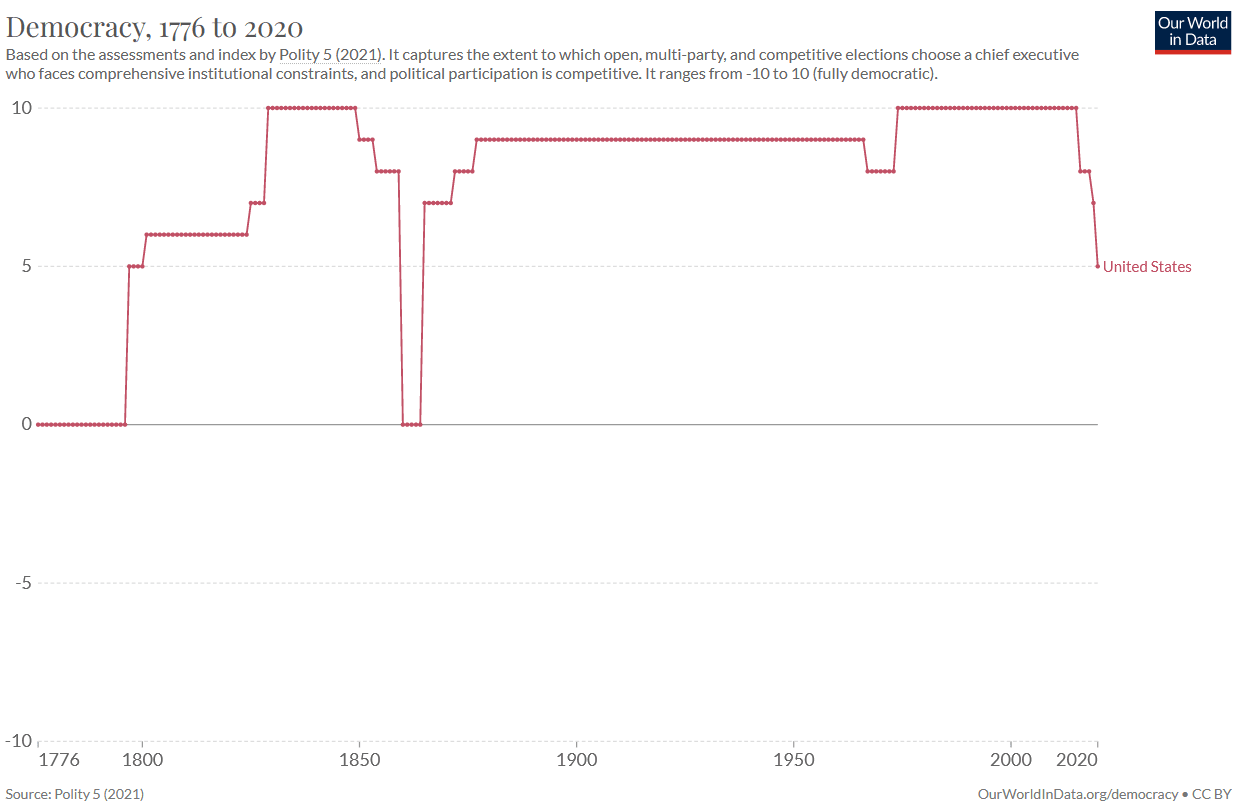 Even then the different datasets do not agree with your statement though - using the Polity dataset again solely because it's the one I showed above, we see world levels of democracy at almost their highest levels ever, in contrast to your VDEM claim that democracy has fallen to mid-1980s levels. One of the biggest drivers for the reduction in capita-weighted-democracy for VDEM is India, but Polity actually records India as being extremely democratic - actually more democratic than the US now! Again, this seems clearly absurd to me.
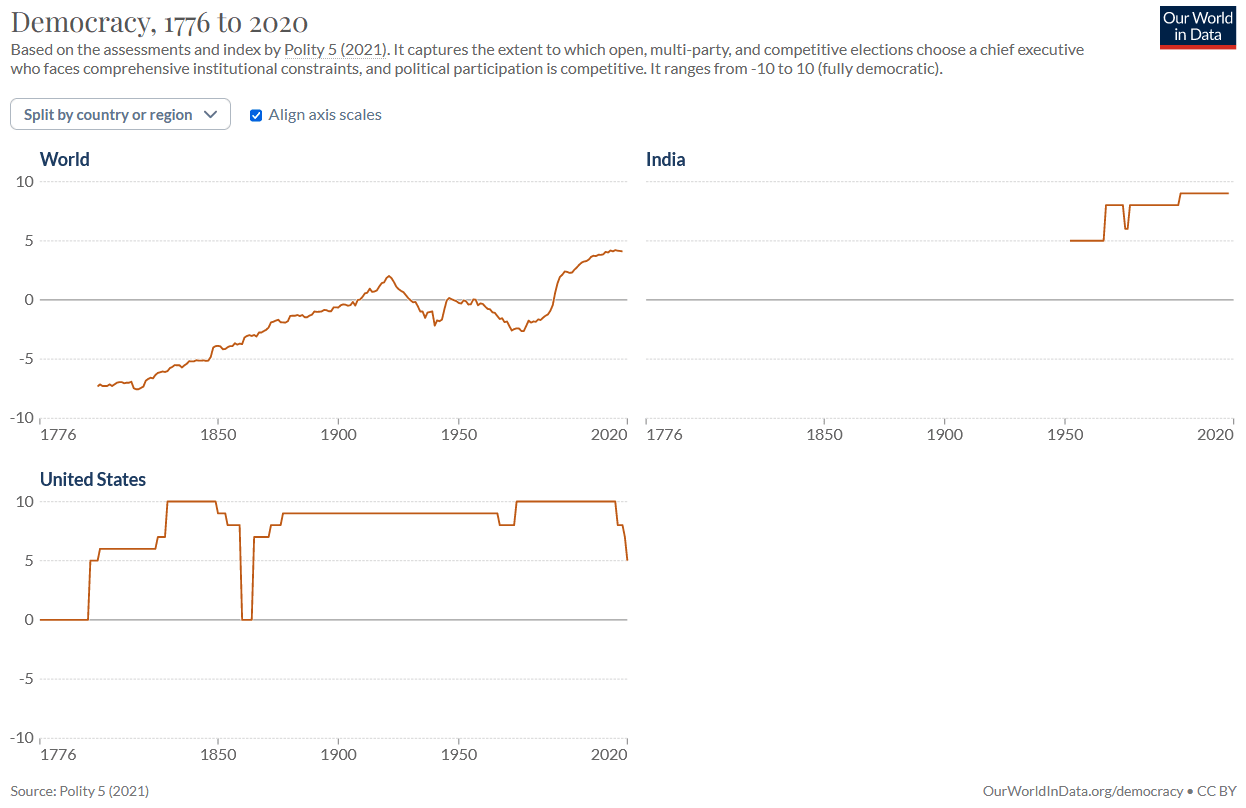
So the mere fact that OWID has a lot of different datasets doesn't seem very reassuring to me, because 1) the one you specifically highlighted as motivating the project seems problematic, and 2) the others seem to vary significantly and also have significant problems.
I also disagree with your implication that because there are "literally millions of interesting specific data points to look at" that this is some sort of implicit p-hacking. I looked at the US first because it is the most important country, and the problems are apparent on the headline measure; you don't have to dive into the sub-components. Similarly, I looked at covid because it is clearly one of the most important events of recent years for human freedom, not because I was going around looking for an issue to pick holes over.
Can I subscribe to a mailing list or similar so I know when you have recommendations for where to donate?
I am really happy to see you starting this. From my lay person perspective it does not seem certain that liberal democracies will survive the next century or two (and this prediction looks sobering at first glance). And the intersection with AI is very interesting. And given the historical lack of democracies, it does not seem given that if most or all current democracies fail, that they are very likely to reappear and dominate like they do today.
Yes: Please scroll down on the webpage https://powerfordemocracies.org/ and register for the Update Service.
I dont see the listing
It's linked to in this paragraph: "Power for Democracies is looking to hire 5-6 democracy enthusiasts to form their ‘Knowledge & Research Team’. "
Correct, thank you Lorenzo!
There is also a (minimalist) job portal where future vacancies will be added: https://powerfordemocracies.kenjo.io/