
Calum Miller
Comments17
While those against abortion have many resources in the US, I don't think that's true in much of the rest of the world. Maybe some parts of Latin America would be another exception, but outside the US the anti-abortion movement is pretty severely underfunded. So I think there is a lot of room for improvement (from an anti-abortion perspective) there.
Regarding adoption, it seems to me that voluntary abortion reduction is not likely to increase the number of people placed for adoption by very much. Even with involuntary abortion denial, the best research we have seems to indicate that most women denied abortions go on to raise the child themselves rather than placing it for adoption. I would guess that this would be even more so if they are voluntarily choosing to continue the pregnancy. Most of these children have perfectly reasonable mental health outcomes. So it seems implausible that this would significantly counterbalance or outweigh the value of the extra lives preserved by voluntary abortion reduction interventions.
Thanks for your question, Ruth. I confess to being a sucker for the liberal democracy post-WW2 human rights deontological framework, according to which involuntary abortion reduction follows from a fairly simple premise: human embryos/foetuses are human beings. If so, then according to the standard human rights framework (specifically ICCPR Article 6) they have a right to life which must be protected in law - i.e. they cannot be killed.
I don't see how a comparable case can be made for the interventions you mention. I know less than nothing about crypto so really couldn't say anything at all about that. Regarding involuntary meat consumption reduction, I don't think non-human animals have a right to life so consuming meat would not be wrong for the same reasons.
Whether meat consumption could reasonably/permissibly be involuntary reduced (I'm not sure why it would be specifically limited to poor countries) for other reasons depends on the facts of the case, I think. I certainly wouldn't have an in principle/absolute objection to doing so if the case for doing so (either from climate concerns, animal suffering, or scarcity) were sufficiently strong. We rationed meat in the war and I don't think that violated any sort of inviolable right to bodily autonomy, for example.
Thank you, Ariel. I was raised as a liberal Christian for whom pretty much anything broadly deemed progressive (including abortion) was permissible, but changed my convictions at medical school :-)
I don't blame you for sticking to voluntary abortion reduction - I think it is a perfectly worthy topic of discussion in itself!
I will do my best to write something up after all. I've always found EA people to be more open-minded and thoughtful than most in philosophy, and I've been encouraged to see the thoughtful and cordial comments among even those who disagree here.
Should have mentioned earlier that in terms of tractability, Hungary might offer the most interesting case study: abortion has not been restricted significantly there at all, but they have reduced the abortion rate from 90,000 in 1990 to just over 20,000 today. This resulted from quite a costly set of pro-family policies which have been widely lauded in pro-family circles, but it is possible that other factors contributed as well (as a nuance to my earlier post, there is good evidence that contraception reduced abortion rates specifically in ex-Soviet countries, probably because sexual behaviour had already changed but abortion had been legalised and was being used as birth control - so contraception substituted more equivalently for it). Hungary abortion numbers: https://www.ksh.hu/stadat_files/nep/hu/nep0013.html
Thank you for a very thoughtful comment. I did just want to add that there are some who do place the possibility of fetal pain earlier - namely, if the cortex is not in fact necessary for conscious experience or pain (https://journals.sagepub.com/doi/full/10.1177/00243639211059245). I realise this is a minority view, but I do think it has some things to commend it (e.g. experiences of pain in those with anencephaly/hydranencephaly).
It's probably worth noting as well that the sheer number of abortions makes even small percentages significant - if only 10% of abortions take place after 12 weeks, that is still 5-7 million or so a year, so plausibly still worth addressing from an EA perspective.
(DOI: I don't take a view of moral status that relies on conscious experiences so would be opposed to abortion even before that)
Thanks, Matt. Sorry I was heading out earlier so didn't have time to elaborate as much as I would have liked. When I say unmet need for contraception (UMC) is low, I meant proportionally - by 2010 it was just over 10%, and I would guess is significantly lower still now. Of course, 10% globally is still a lot of people, but these are presumably the hardest people to reach and it is not clear how cost-effective doing so would be - moreover, it seems clear that even if we did manage to reach those 10%, the abortion rate would hardly decline by that much - so it is a pretty limited strategy for reducing abortions, if it is effective at all.
Regarding the second paper, table 5 indicates that only 8% of women with UMC globally lacked access (including because of cost). Table 3 in the third paper shows similar. So it still seems that only a very small proportion of women globally - perhaps 1% in 2010 - have a UMC because of lack of access to contraception.
There probably are interventions which could increase contraceptive uptake - but I don't think they are by any means simple, and they are not generally solving lack of access per se. The access is there, even if the relevant education or empowerment of women is not. As indicated in the rest of my previous post, even if this were solved, it is still not clear to me that it would reduce abortions, given the counterbalancing effects contraception promotion has on sexual behaviour and desired family size. It seems particularly doubtful that it would reduce abortions by a large amount.
You are right that as education increases, desired family size generally falls, and contraception demand will grow. But I don't see that there is a significant risk of contraception supply failing anytime soon. Even under the Mexico City Policy, which was widely held to significantly impede access to contraception, contraceptive use in the affected countries (turquoise - unaffected countries in orange) rapidly increased: 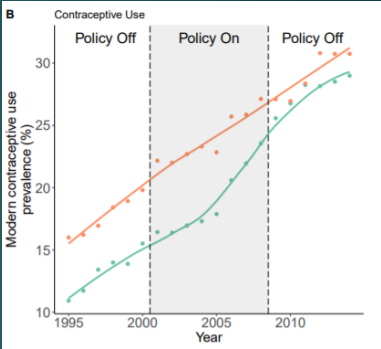
This, I suppose, is relevant to the EA discourse on neglectedness - with the emphasis on contraception in international development circles, it seems unlikely that slightly trimmed down support for it is going to significantly impede it or significantly increase abortion rates. But I confess I am only really on the peripheries of EA so I might be outdated with the neglectedness stuff.
I don't think there is strong evidence that legalisation of abortion reduces overall maternal deaths from abortion mortality or morbidity - in some cases, it can even increase it (as it has done in e.g. Netherlands, Ethiopia, Rwanda, and some others). Morbidity and mortality from unsafe abortion are mostly related to the overall state of a healthcare system rather than the legal status of abortion - e.g. Malta and Poland have pretty much entirely anti-abortion laws but have the lowest maternal mortality ratios in the world and deaths from unsafe abortion are unheard of. By contrast India, Ghana, Zambia, Ethiopia, Bangladesh and a host of other countries have liberal laws but have plenty of unsafe abortion and resultant morbidity/mortality.
We do know that the WHO misrepresent the data on this, too - e.g. here https://www.who.int/news-room/fact-sheets/detail/abortion they claim that 4.7-13.2% of maternal deaths are due to abortion - but their reference clearly states that this includes deaths from miscarriage and ectopic pregnancies. They have been corrected about this but refuse to change it - so I don't consider them the most trustworthy authorities on this question.
Thanks for asking, Bruce. Yes, regarding contraception increasing risky sex, it's been a while since I looked at this literature but here are some of the references from my notes on it:
https://www.tandfonline.com/doi/abs/10.1080/07350015.2011.652052
https://onlinelibrary.wiley.com/doi/full/10.1111/ecin.12757
https://www.amazon.co.uk/AIDS-Behavior-Culture-Questions-Anthropology/dp/1598744798
https://pubmed.ncbi.nlm.nih.gov/11939239/
https://www.thelancet.com/journals/lancet/article/PIIS0140673606697870/fulltext
On unwantedness of pregnancy: https://pubmed.ncbi.nlm.nih.gov/31196674/ and Relationships Between Contraception and Abortion: A Review of the Evidence (guttmacher.org)
For low unmet need for contraception in developing countries: https://pubmed.ncbi.nlm.nih.gov/23489750/
And for low proportion of unmet need attributable to lack of access: https://www.guttmacher.org/sites/default/files/pdfs/pubs/Contraceptive-Technologies.pdf and https://pubmed.ncbi.nlm.nih.gov/24931073/
Yes - I don't want to speak for Ariel, but my sense is that we have pretty different perspectives on why abortion is bad. I have a fairly traditional pro-life position unrelated to population ethics or utilitarian considerations. I generally think children are a good thing for various reasons, but I'm not into maximising population for population ethics reasons or anything like that.
Even for LARCs I'm pretty sceptical that their promotion significantly reduces abortions except in exceptional circumstances (e.g. former soviet states where abortion was used as birth control). But I would support other interventions which, for example, hardcore pronatalists might well oppose (e.g. education encouraging delay of sexual debut, discouragement of multiple sexual partners, bans on surrogacy, etc.).