

Adam Binks
Bio
I'm building tools for forecasting and thinking at Sage. Currently building Quantified Intuitions and Fatebook.
Previously I was doing a PhD in HCI at St Andrews, and worked at Clearer Thinking.
Website: http://adambinks.me/
Tweeting, sometimes about EA: https://twitter.com/adambinks_
Posts 8
Comments66
Topic contributions1
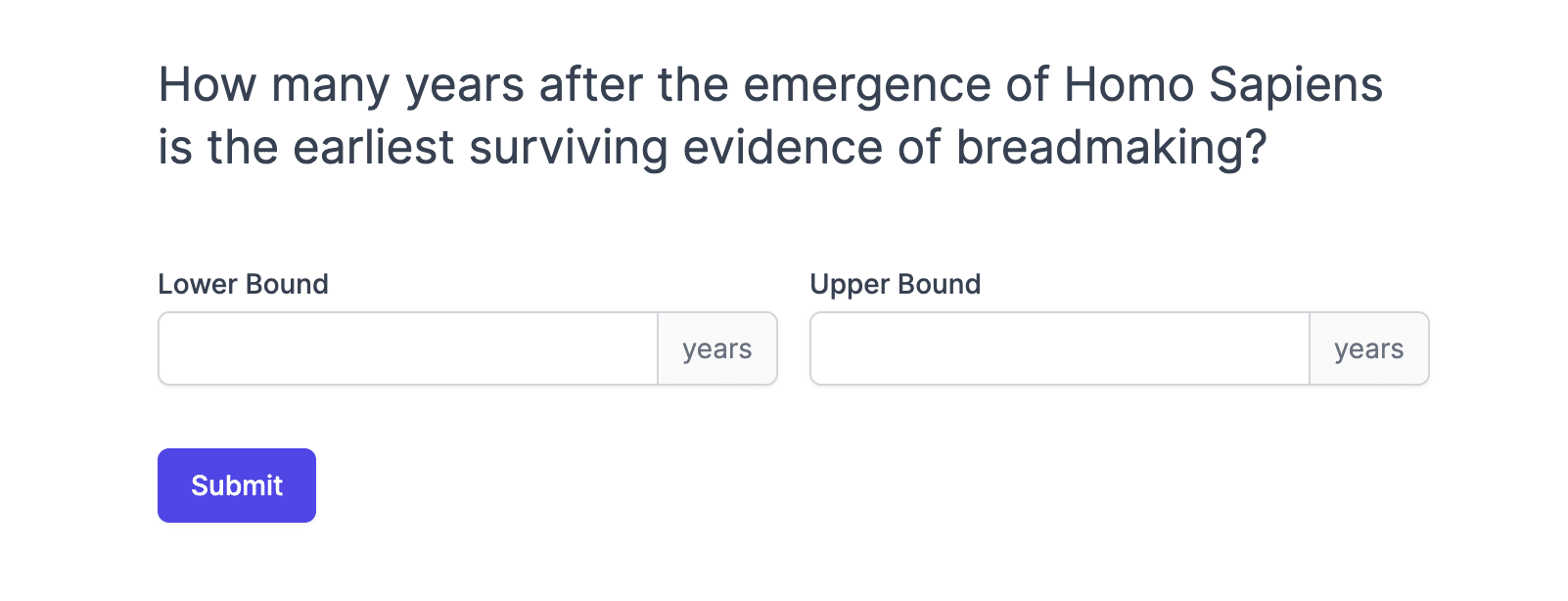
The July Estimation Game is now live: a 10 question Fermi estimation game all about big picture history! https://quantifiedintuitions.org/estimation-game/july
Question 1:
Thank you!
Do you look at non-anonymized user data in your analytics and tracking?
No - we don't look at non-anonymised user data in our analytics. We use Google Analytics events, so we can see e.g. a graph of how many forecasts are made each day, and this tracks the ID of each user so we can see e.g. how many users made forecasts each day (to disambiguate a small number of power-users from lots of light users). IDs are random strings of text that might look like cwudksndspdkwj. I think you'd call technically this "pseudo-anonymised" because user IDs are stored, not sure!
Who specifically gets access to user submitted predictions (can't quite tell how large your team is, for instance)
Your predictions are private to you unless you share them. I and the other two devs who have helped out with parts of the project have access to the production database, but we commit to not looking at users' questions unless you specifically share them with us (e.g. to help us debug something). I am interested in encrypting the questions in the database so that we're unable to theoretically access them, but haven't got round to implementing this yet (I want to focus on some bigger user-visible improvements first!)
Hope this makes sense! Thanks for your kind words and for checking about this, let me know if you think we could improve on any of this!
Thank you! I'm interested to hear how you find it!
often lacks the motivation to do so consistently
Very relatable! The 10 Conditions for Change framework might be helping for thinking of ways to do it more consistently (if on reflection you really want to!) Fatebook aims to help with 1, 2, 4, 7, and 8, I think.
One way to do more prediction I'm interested in is integrating prediction into workflows. Here are some made-up examples:
- At the start of a work project, you always forecast how long it'll take (I think this is almost always an important question, and getting good at predicting this is powerful)
- When you notice you're concerned about some uncertainty (e.g. some risk) you operationalise it and write it down as a question
- In your weekly review with your manager, you make forecasts about how likely you are to meet each of your goals. Then you discuss strategies to raise the P(success) on the important goals
- When there's a disagreement two team members about what to prioritise, you make operationalise it as a forecasting question, and get the whole team's view. If the team as a whole disagrees, you look for ways to get more information, or if the team agrees (after sharing info) you follow that prioitisation
If anyone that either has prediction as part of workflows or would like to do so would be interested in chatting, lmk!
In many ways Fatebook is a successor to PredictionBook (now >11 years old!) If you've used PredictionBook in the past, you can import all your PredictionBook questions and scores to Fatebook.
In a perfect world, this would also integrate with Alfred on my mac so that it becomes extremely easy and quick to create a new private question
I'm thinking of creating a Chrome extension that will let you type /forecast Will x happen? anywhere on the internet, and it'll create and embed an interactive Fatebook question.
I'm thinking of primarily focussing on Google Docs, because I think the EA community could get a lot of mileage out of making and tracking predictions embedded in reports, strategy docs, etc. This extension would also work in messaging apps, on social media, and even here on the forum (though first-party support might be better for the forum!).
Great, thanks!
The format could be "[question text]? [resolve date]" where the question mark serves as the indicator for the end of the question text, and the resolve date part can interpret things like "1w", "1y", "eoy", "5d"
I'm interested in adding power user shortcuts like this!
Currently, if your question text includes a date that Fatebook can recognise, it'll prepopulate the "Resolve by" field with that date. This works for a bunch of common phrases, e.g. "in two weeks" "by next month" "by Jan 2025" "by February" "by tomorrow".
If you play around with the site, I'd be interested to hear if you find yourself still keen for the addition of concise shortcuts like "2w" or if the current natural language date parsing works well for you.
The June Estimation Game is animal welfare + alt proteins themed! 10 Fermi estimation questions. You can play here: quantifiedintuitions.org/estimation-game/june
Ah thank you! I've just pushed what should be a fix for this (hard to fully test as I'm in the UK).